Anthropic Study: 69% of Workers Hide AI Use Despite 86% Saying It Saves Time
New study of 1,250 professionals reveals the AI workplace paradox: most workers use AI daily but face stigma for admitting it. Here's what they told Anthropic.
The Secret Everyone Knows
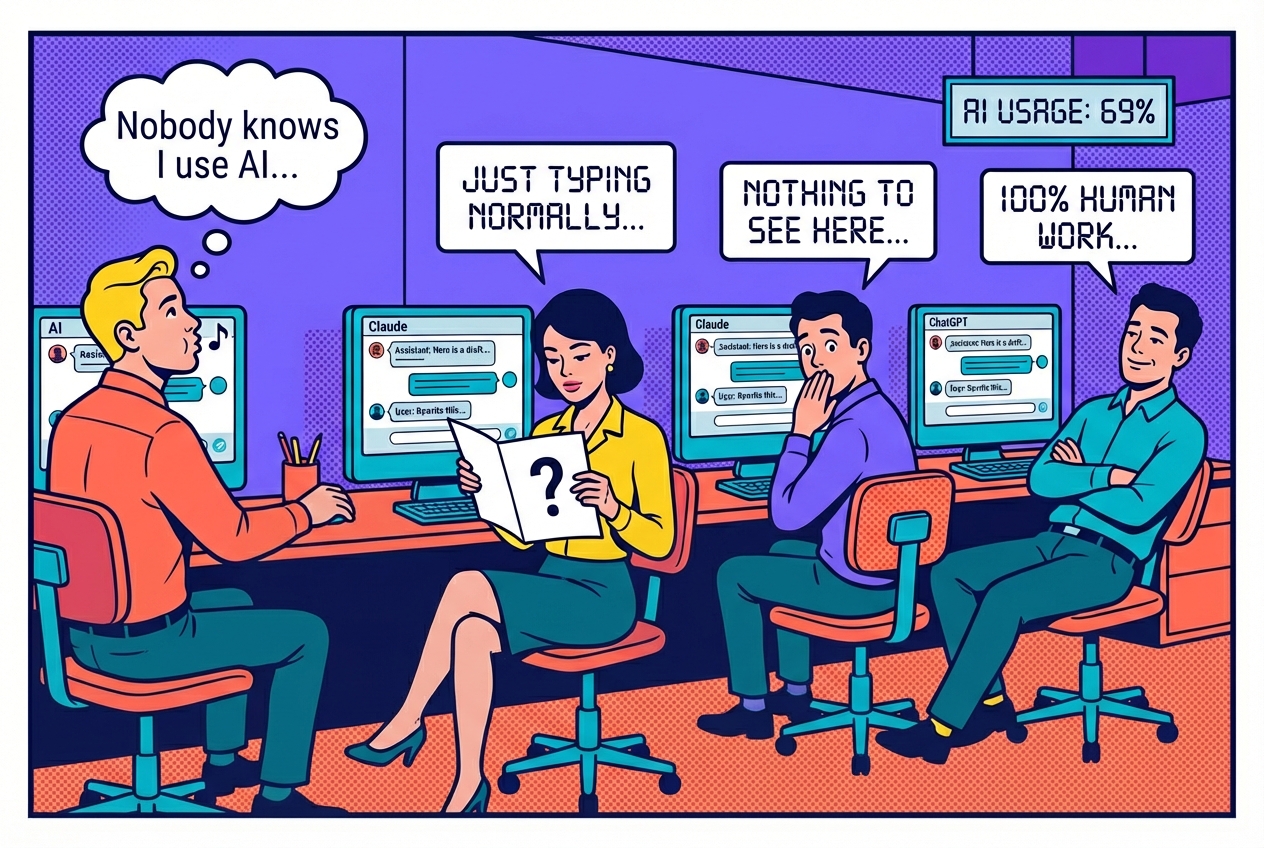
Here's the awkward truth about AI at work in 2025: almost everyone is using it, and almost everyone is pretending they're not.
Anthropic just put numbers to what many of us suspected. In a new study of 1,250 professionals, 69% reported facing stigma around using AI tools at work—even though 86% say AI saves them time. That's not a contradiction. That's a workplace culture problem.
TL;DR: What the Study Found
| Key Finding | What It Means |
|---|---|
| 86% say AI saves time | The productivity benefit is real and widespread |
| 69% face workplace stigma | But admitting you use it? That's still taboo |
| 48% considering AI management roles | Workers are already planning their pivot |
| 55% anxious about future | Even beneficiaries aren't feeling secure |
| Creatives: 97% efficiency gain | Creative professionals benefit most, but... |
| Creatives: 70% face peer judgment | ...they also face the harshest stigma |
The bottom line: AI usage is widespread. AI disclosure is not. Workers are caught in a paradox where they fear falling behind if they don't use AI, but fear showing what can be automated if they do.
How Anthropic Measured This
Anthropic developed a new AI-powered interview tool and used it to conduct in-depth conversations with 1,250 professionals:
- 1,000 general workforce participants
- 125 creative professionals
- 125 scientists (physicists, chemists, data scientists, and 50+ other disciplines)
The methodology is significant: rather than simple surveys, the AI interviewer conducted conversational interviews that captured nuance, emotion, and contradiction in how people actually talk about AI at work.
The General Workforce: Productivity vs. Stigma
The headline numbers tell a story of cognitive dissonance:
The Good:
- 86% reported AI saves them time
- 65% are satisfied with AI's role in their work
- 41% feel secure, believing human skills remain irreplaceable
The Complicated:
- 69% mentioned social stigma around using AI tools
- 55% expressed anxiety about AI's impact on their future
- Only 8% expressed anxiety without any plan to adapt
That last number is actually encouraging. Most workers aren't paralyzed—they're strategizing.
The Paradox: What Workers Say vs. What They Do
Here's where it gets interesting. When asked to describe their AI usage:
- 65% described it as "augmentative" (collaborative enhancement)
- 35% described it as "automative" (task replacement)
But when Anthropic analyzed actual Claude usage patterns, the split was different:
- 47% augmentation
- 49% automation
Workers are doing more automation than they're willing to admit—even to an AI interviewer. The stigma runs deep enough that we're downplaying our own AI usage to ourselves.
The Career Pivot Signal
Perhaps the most forward-looking finding: 48% of workers are considering transitioning toward careers focused on managing AI systems rather than performing technical work directly.
Nearly half the workforce is already thinking about how to position themselves above AI rather than alongside it. That's not panic—that's adaptation in real time.
Creative Professionals: The Sharpest Paradox
Creative workers showed the most extreme version of the AI stigma paradox:
Efficiency gains are massive:
- 97% reported AI saved them time
- 68% said it increased their work quality
But the social cost is high:
- 70% manage peer judgment about AI usage
- All 125 creative professionals mentioned wanting to maintain control over their core creative work
- Many acknowledged moments where AI "drove decisions" even when they wanted to stay in control
The creative community is wrestling with fundamental questions about authorship, authenticity, and what "their work" even means in an AI-assisted world.
Scientists: Trust as the Barrier
Scientists approached AI differently. Their hesitation wasn't about stigma—it was about reliability:
- 79% cited trust and reliability concerns as primary barriers
- 27% mentioned technical limitations
- Yet 91% wanted stronger AI tools functioning as research partners
Current usage patterns reflect this caution. Scientists confined AI to support tasks:
- Literature review
- Coding assistance
- Writing and documentation
They specifically avoided using AI for core research tasks like hypothesis generation and experimental design. The desire for AI partnership is there—but the trust isn't. Yet.
The "Damned If You Do" Dilemma
Anthropic's researchers identified a fundamental fear that cuts across all groups:
If they do not use AI, they worry they will fall behind. If they lean on it too much, they worry they are showing their employers what tasks can be automated.
This is the core anxiety of AI at work in 2025. It's not really about the technology. It's about what using it signals:
- Use AI openly → Risk being seen as dispensable ("A robot could do your job")
- Avoid AI → Risk being seen as outdated ("You're falling behind")
- Use AI secretly → The current equilibrium for 69% of workers
What This Means For You
If You're Hiding Your AI Use
You're not alone—69% of workers are doing the same thing. But the stigma is likely to fade as AI use becomes undeniable. Early disclosure, framed correctly, positions you as forward-thinking rather than replaceable.
The framing matters: "I use AI to handle routine tasks so I can focus on higher-value work" beats "AI does a lot of my job."
If You're Anxious About AI
The 55% anxiety rate is real, but note that only 8% are anxious without a plan. Having a strategy—any strategy—correlates with feeling more in control.
Consider the 48% who are pivoting toward AI management roles. That's not giving up on your profession; it's evolving with it.
If You're in a Creative Field
The 97% time savings is real. So is the 70% peer judgment. The creative community is working through questions about AI and authenticity in real time.
The professionals succeeding are those who can articulate which parts of their work are irreducibly human—the vision, the taste, the judgment calls—and use AI to handle everything else.
If You're in Research or Science
Trust is the appropriate barrier. AI hallucinations are real, and scientific integrity matters more than efficiency. But the 91% who want better AI tools will eventually get them.
Position yourself to evaluate and integrate those tools when they become trustworthy, rather than scrambling to catch up.
The Bigger Picture
This study captures a moment of transition. AI usage is nearly universal. AI acceptance is lagging behind. The 69% stigma rate will likely decrease as the productivity benefits become impossible to ignore.
But the underlying tension won't disappear. Workers will continue navigating the question of how visible to be about their AI usage, balancing productivity against perception.
The workers who will thrive aren't necessarily the ones using AI most heavily—they're the ones who can articulate why their human judgment, creativity, and accountability matter more than ever because AI handles the rest.
Method & Sources
Primary Source: Anthropic's "Anthropic Interviewer" study, surveying 1,250 professionals (1,000 general workforce, 125 creatives, 125 scientists) using AI-powered conversational interviews. Published December 5, 2025.
Coverage:
- Anthropic Official Announcement: Introducing Anthropic Interviewer (December 5, 2025)
- Final Round AI: Anthropic Study Finds Most Workers Use AI Daily, but 69 Percent Hide It at Work (December 5, 2025)
Related Reading:
- MIT Study: 11.7% of US Jobs Already Replaceable by AI — The data on which jobs AI can actually do today
- What People Actually Pay For — Why trust, judgment, and accountability still matter
- Software Engineer Risk Assessment — How AI is reshaping developer roles