Administrative Assistant
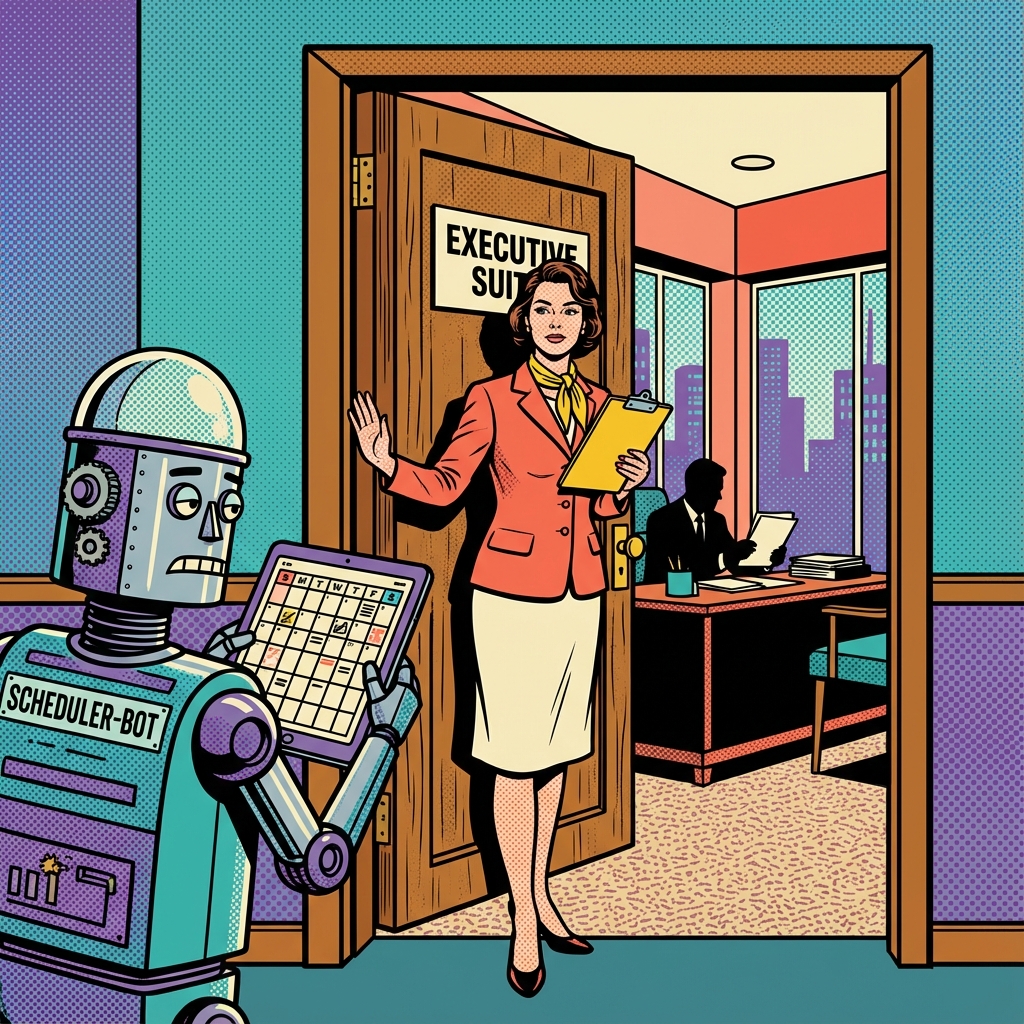
Will AI replace administrative assistants? At 55% risk, routine scheduling is automating. But the trusted advisor who makes judgment calls? More valuable than ever.
The administrative assistant role is splitting: routine scheduling and coordination tasks are being automated, while the trusted advisor and organizational intelligence roles are growing. Success means evolving from task executor to strategic partner.
Will Robots Take My Administrative Assistant Job?
You've seen the AI scheduling tools. The email auto-responders. The travel booking bots. If your job involves managing calendars and booking conference rooms, you're probably wondering if there's a place for you in five years. Here's what's actually happening.
We've Been Here Before: The Secretarial Pool to Executive Assistant
In the 1970s, large companies employed typing pools—rooms of secretaries handling correspondence for the organization. Word processors eliminated those roles.
But they didn't eliminate administrative support. The role evolved:
- Then: Typing, filing, dictation
- Now: Strategic calendar management, stakeholder coordination, executive support
The professionals who adapted became executive assistants—trusted partners to leadership, not typists.
The pattern: Technology eliminates tasks, not relationships. The question is which administrative professionals will make the transition again.
What AI Can Actually Do Today
Tasks AI Handles Well:
Scheduling & Calendar:
- AI scheduling assistants find meeting times automatically
- Auto-scheduling based on preferences and priorities
- Calendar conflict resolution
- Meeting room booking
Email & Communication:
- Email triage and categorization
- Draft responses to routine messages
- Summarize email threads
- Track action items from messages
Travel & Logistics:
- Book flights and hotels based on preferences
- Generate travel itineraries
- Track expenses and receipts
- Handle standard travel changes
Document & Information:
- Format and proofread documents
- Generate meeting agendas and notes
- Research and summarize information
- Create presentation drafts
What Humans Still Win:
Judgment Calls:
- Which meeting should be rescheduled vs. protected?
- What does "as soon as possible" mean for THIS executive?
- When should an email be escalated vs. handled?
- How to navigate political dynamics in scheduling?
Relationship Management:
- Knowing who to call when something needs to happen fast
- Understanding the real priorities behind the stated ones
- Managing expectations with diplomats and difficult personalities
- Being the human face of an executive's calendar
Organizational Intelligence:
- Knowing the unwritten rules
- Understanding who really makes decisions
- Tracking informal commitments and relationships
- Anticipating needs before they're expressed
Crisis Management:
- Handling unexpected situations with judgment
- Adapting quickly when plans fall apart
- Protecting executives from chaos while solving problems
- Making calls when the boss isn't available
The Tasks Table: Robot vs Human
| Task | AI Capability | Human Advantage | Winner |
|---|---|---|---|
| Find meeting times | 90% | 10% - relationship context | AI |
| Book standard travel | 85% | 15% - preferences | AI |
| Email categorization | 80% | 20% - nuance | AI |
| Draft routine responses | 75% | 25% - tone | AI |
| Meeting notes/summaries | 80% | 20% - priority identification | AI |
| Protect executive's time | 30% | 70% - judgment | Human |
| Navigate office politics | 15% | 85% - relationship knowledge | Human |
| Anticipate needs | 20% | 80% - pattern recognition | Human |
| Handle crises | 25% | 75% - judgment + action | Human |
| Be trusted advisor | 10% | 90% - relationship + discretion | Human |
The summary: AI wins at mechanics. Humans win at judgment and relationships.
The Role Is Splitting
The Disappearing Role: Task Executor
If your job is primarily:
- Scheduling meetings when asked
- Booking travel when requested
- Answering routine correspondence
- Managing expense reports
- Basic document formatting
This version of the role is shrinking. AI tools can handle these tasks, and executives are increasingly doing simple scheduling themselves with AI assistance.
The Growing Role: Strategic Partner
If your job involves:
- Protecting an executive's time and priorities
- Managing complex stakeholder relationships
- Being the organizational memory
- Making judgment calls on their behalf
- Handling sensitive situations with discretion
This version of the role is growing in value. It's also being renamed: Chief of Staff, Executive Business Partner, Director of Operations.
The pay gap reflects this split:
- Task-focused admin: $35,000-$55,000 (shrinking)
- Strategic partner: $80,000-$150,000 (growing)
The AI Ecosystem Around Administrative Work
It's not just your tasks that are changing. The entire environment is shifting.
Meeting Management:
- AI transcribes and summarizes meetings
- Action items auto-extracted
- Follow-up reminders automated
- Calendar automatically updated with decisions
Email Handling:
- Executives using AI to draft responses
- AI prioritizing inboxes
- Auto-responses for routine queries
- Summary digests of email content
Document Preparation:
- AI generating first drafts
- Automated formatting and proofing
- Research compiled automatically
- Presentation generation
What this means for you: The mechanical parts of your job are shrinking. The question is whether you can fill the expanding space with judgment, relationships, and strategic value.
The Path Forward: From Admin to Strategic Partner
Step 1: Audit Your Current Value
Ask yourself honestly:
- What tasks do I do that AI could handle?
- What do I do that requires knowing my executive personally?
- What judgment calls do I make daily?
- What would break if I weren't there?
The answers reveal your automation risk and your strategic value.
Step 2: Expand the Strategic Elements
Relationship Management:
- Become the person who knows everyone's working style
- Build relationships that help get things done
- Be the one who knows the real story behind decisions
Organizational Intelligence:
- Track commitments, promises, and relationships
- Understand informal power structures
- Anticipate issues before they become problems
Judgment and Decision-Making:
- Take on more decision-making responsibility
- Handle situations without needing to escalate
- Become trusted to act on behalf of your executive
Step 3: Learn the AI Tools
Don't avoid AI—master it:
- Learn the scheduling AI tools so you can augment them
- Use AI to handle mechanical tasks so you have time for strategic work
- Become the person who makes AI work better, not competes with it
Step 4: Position for Growth
If staying in admin track:
- Target Chief of Staff or Executive Business Partner roles
- Build toward supporting C-suite executives
- Develop specialization (board relations, investor relations, etc.)
If pivoting:
- Operations management (your organizational knowledge is valuable)
- Project management (coordination skills transfer)
- Client success / relationship management
- Office of the CEO roles
The Bottom Line
The administrative assistant role is transforming, not disappearing. The mechanical tasks—scheduling, booking, formatting—are automating. The strategic value—judgment, relationships, organizational intelligence—is growing.
The uncomfortable truth: There will be fewer administrative roles. Companies that employed five admins may employ two.
The opportunity: The remaining roles are higher-level, higher-paid, and more strategic. The professionals who make the transition become invaluable partners, not replaceable task executors.
Your move: Look at your day. How much is mechanical vs. strategic? If it's 80% mechanical, start building your strategic portfolio now. If it's already 50%+ strategic, lean into it—you're positioned for the future of the role.
What's Next?
Ready to future-proof your career? Our AI Adaptation Guide covers the skills and strategies that matter across every profession—from embracing AI tools to doubling down on uniquely human strengths.