
Construction Worker
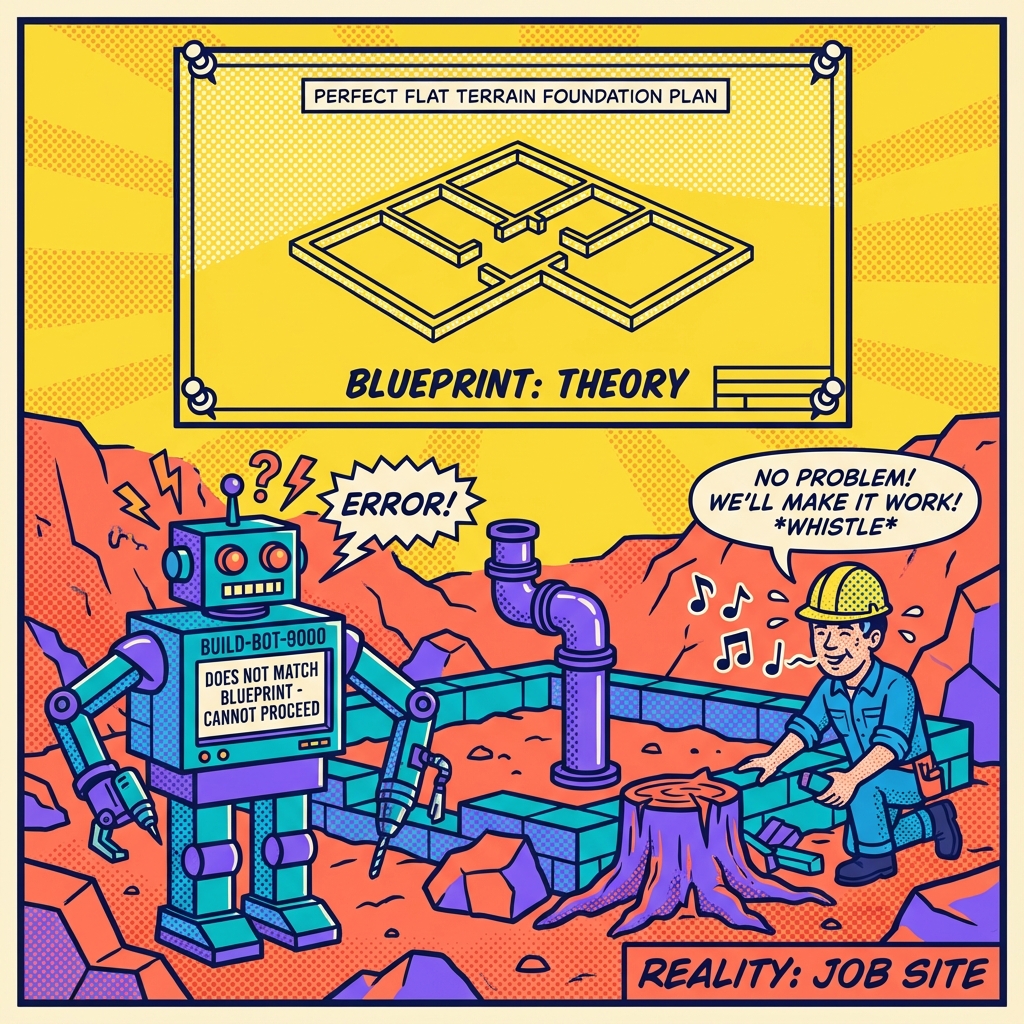
Will robots replace construction workers? At 30% risk, probably not soon. Every job site is different, and robots can't figure out what to do when the blueprint doesn't match reality.
Drones can survey sites and robots can lay bricks in labs, but real construction happens in messy, unpredictable environments where human problem-solving is essential. The workers who win are already in demand.
Will Robots Take My Construction Job?
You're here because you saw a video of a robot laying bricks perfectly and wondered if your job was next. Here's what's actually happening.
We've Been Here Before: Prefab Didn't Replace Construction Workers
In the 1950s, prefabricated housing was going to eliminate on-site construction. Then modular building. Then 3D printing. Then robotic bricklaying.
Construction employment is projected to grow 4% through 2032, and the industry can't find enough workers.
Why? Because developers don't pay for bricks laid. They pay for:
- Getting the job done despite surprises
- Adapting when the site doesn't match the plan
- Solving problems in real-time
- Working safely in hazardous conditions
- Physical work in spaces robots can't access
- Coordinating across trades and teams
Robots can lay 1,000 bricks an hour on a flat surface. They can't figure out what to do when they hit a pipe nobody knew was there.
What Robots/Drones Can Actually Do Today
Tasks Automation Wins At:
- Site surveying - Drones mapping terrain (fast and accurate)
- Concrete pouring - Automated concrete pumps
- Rebar tying - Repetitive, back-breaking work
- Material transport - Moving heavy loads on flat surfaces
- Demolition - Controlled robotic demolition
What Humans Still Dominate:
- Problem-solving - Adapting to unexpected conditions
- Finishing work - Quality that requires judgment
- Confined spaces - Work in areas robots can't access
- Complex installations - HVAC, plumbing, electrical coordination
- Safety judgment - Real-time hazard assessment
- Custom work - Every job site is different
The Tasks Table: Robot vs Human
| Task | Robot Capability | Human Advantage | Winner |
|---|---|---|---|
| Site surveying | 85% | 15% - interpretation | Robot |
| Concrete pumping | 75% | 25% - quality decisions | Tie |
| Heavy lifting | 70% | 30% - access limitations | Tie |
| Repetitive bricklaying | 60% | 40% - site adaptation | Human |
| Problem-solving | 15% | 85% - unexpected situations | Human |
| Finishing work | 20% | 80% - quality judgment | Human |
| Safety response | 10% | 90% - immediate judgment | Human |
| Trade coordination | 15% | 85% - communication | Human |
| Custom fabrication | 25% | 75% - creativity + skill | Human |
The Counter-Narrative: Construction Has a People Problem, Not a Robot Problem
Here's the surprising reality:
650,000 worker shortage in 2023 Average age: 42 and rising $1.2 trillion infrastructure bill creating massive demand Housing shortage requires millions more homes
Robots aren't threatening construction workers—the real crisis is not enough people entering the trades.
The real transformation:
- Drones help with surveying and safety
- Robots handle the most dangerous/repetitive tasks
- Humans become more productive with tech assistance
- Skilled workers become even more valuable
The Bottom Line
Yes, drones will survey sites and robots will handle some repetitive tasks. No, robots won't figure out what to do when the foundation doesn't match the blueprint.
The workers who thrive will be:
- Problem-solvers (handling what robots can't)
- Tech-comfortable (using drones and software)
- Skilled tradespeople (specialization = value)
- Safety-focused (keeping sites running smoothly)
Your move: Get a specialty certification this quarter. The workers who struggle won't be replaced by robots—they'll miss the biggest construction opportunity in generations.
What's Next?
Ready to future-proof your career? Our AI Adaptation Guide covers the skills and strategies that matter across every profession—from embracing AI tools to doubling down on uniquely human strengths.