Customer Service Rep
Will AI replace customer service reps? At 70% risk, Tier 1 is automating fast. But escalations and angry customers? Still need humans who actually listen.
Chatbots are handling routine questions faster and cheaper, but escalations, complaints, and emotional situations still need humans. The reps who win will handle what makes robots say 'let me transfer you.'
Will Robots Take My Customer Service Job?
You're here because you've used a chatbot that actually worked for once, and you wondered if your job was next. Here's what's actually happening.
We've Been Here Before: Phone Trees Didn't End Customer Service
In the 1990s, automated phone trees were going to eliminate customer service reps. Then FAQ websites. Then offshore call centers. Then first-generation chatbots.
Companies that eliminated human customer service watched their customer satisfaction (and business) tank.
Why? Because customers don't call for information. They call because:
- They're frustrated and need someone to listen
- The self-service option didn't work
- Their situation is complicated
- They need someone to bend the rules
- They want to feel heard
- They need a human to take responsibility
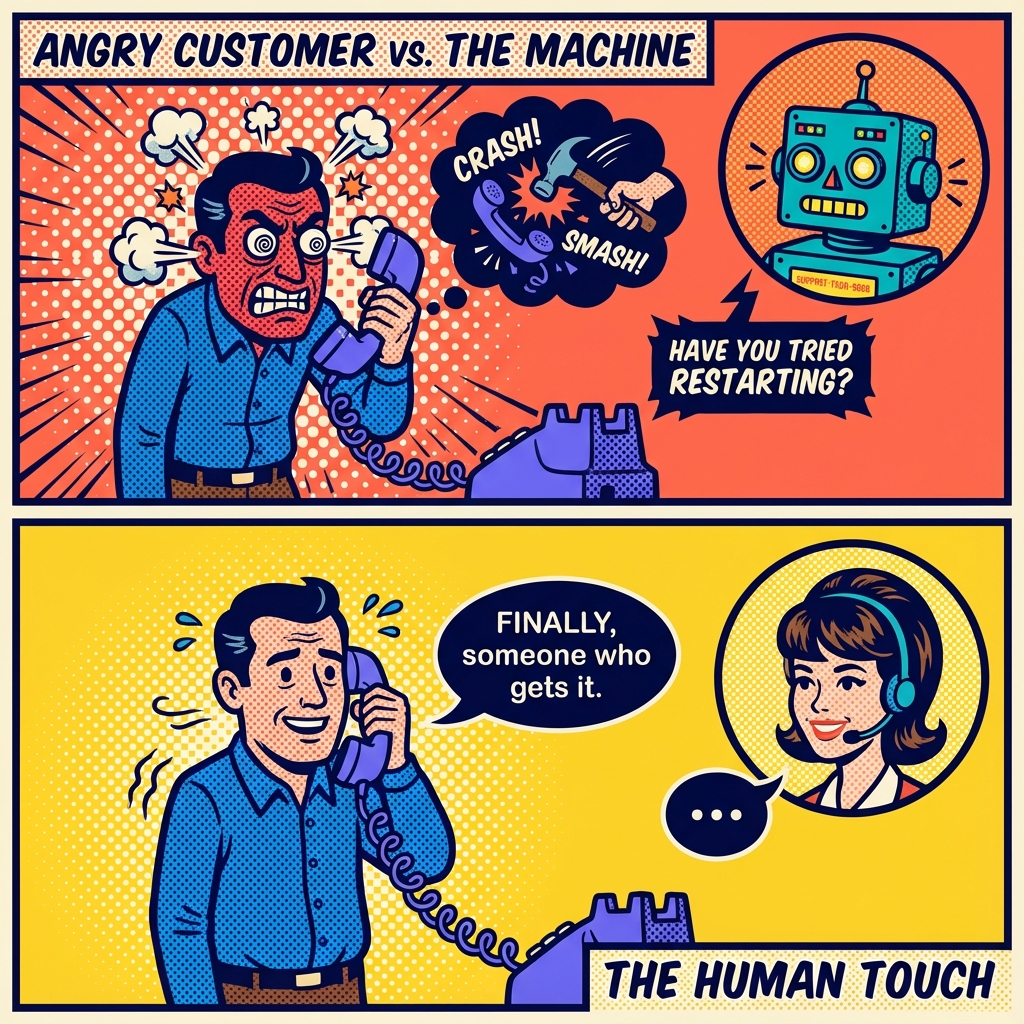
Chatbots can answer "What are your hours?" They can't handle "I'm crying because your product ruined my wedding."
What AI Can Actually Do Today
Tasks AI Wins At:
- FAQ responses - Standard questions, instant answers (95%+ accuracy)
- Order status - Tracking information, delivery updates
- Password resets - Automated account recovery
- Basic troubleshooting - Guided steps for common issues
- Appointment scheduling - Calendar-based booking
What Humans Still Dominate:
- Escalations - When the script doesn't cover it
- Emotional situations - Angry, upset, or distressed customers
- Complaint resolution - Judgment calls on compensation
- Complex problems - Multi-factor issues without clear solutions
- Relationship building - High-value customer retention
- Policy exceptions - Knowing when to bend the rules
The Tasks Table: Robot vs Human
| Task | AI Capability | Human Advantage | Winner |
|---|---|---|---|
| FAQ responses | 95% | 5% - unusual variations | AI |
| Order tracking | 90% | 10% - discrepancy resolution | AI |
| Password reset | 95% | 5% - identity verification edge cases | AI |
| Basic troubleshooting | 75% | 25% - creative solutions | Tie |
| Complaint handling | 30% | 70% - empathy + judgment | Human |
| Emotional de-escalation | 15% | 85% - genuine human connection | Human |
| Complex problem-solving | 25% | 75% - creative solutions | Human |
| Policy exceptions | 10% | 90% - judgment + authority | Human |
| Retention offers | 35% | 65% - negotiation + reading customer | Human |
The Counter-Narrative: AI Creates Different Customer Service Jobs
Here's the surprising reality:
Customer expectations are higher than ever Chatbot failures create angrier escalations High-value customers demand human touch Social media complaints require human response
AI isn't eliminating customer service—it's eliminating the easy stuff.
The real transformation:
- Tier 1 (simple inquiries) → Fully automated
- Tier 2 (complex issues) → Fewer, more skilled humans
- Tier 3 (escalations) → Premium human-only support
- Social media/chat → Hybrid human-AI teams
The Bottom Line
Yes, chatbots will handle routine inquiries and basic troubleshooting. No, chatbots won't calm down an angry customer or make judgment calls on compensation.
The reps who thrive will be:
- Escalation experts (handling what AI can't)
- Emotionally intelligent (genuine empathy, not scripts)
- Problem-solvers (creative solutions for complex issues)
- High-value specialists (retention, VIP, enterprise)
Your move: Volunteer for the difficult calls this week. The reps who struggle won't be replaced by chatbots—they'll be replaced by reps who can handle what chatbots can't.
What's Next?
Ready to future-proof your career? Our AI Adaptation Guide covers the skills and strategies that matter across every profession—from embracing AI tools to doubling down on uniquely human strengths.