Dentist
Will AI replace dentists? At 25% risk, probably not. The real threat is paperwork burnout—and AI might actually save your sanity.
AI is becoming your diagnostic co-pilot and killing your paperwork, not taking your drill. The dentists who win will spend less time charting and more time chairside.
Will AI Take My Dentist Job?
You saw another headline about AI detecting cavities better than dentists, and now you're wondering if dental school was a $300,000 mistake.
Deep breath. Here's what's actually happening.
We've Been Here Before
The dental profession has a long history of surviving "existential threats":
- 1895: X-rays would replace clinical examination
- 1980s: CAD/CAM would eliminate the need for skilled hands
- 2000s: Patients would diagnose themselves on WebMD
- 2010s: Corporate dentistry would turn you into a tooth technician
Plot twist: There are MORE dentists today than ever, earning MORE than ever.
Why? Because patients don't pay for cavity detection. They pay for:
- Someone they trust to put sharp instruments in their mouth
- The person who takes responsibility when things go sideways
- Hands that can actually fix the problem
- That reassuring "you're going to be fine" (which hits different from a chatbot)
AI can flag a suspicious lesion. It can't perform a root canal or calm down a terrified 8-year-old.
AI in Dentistry: What It Can Do Today
This isn't theoretical—surveys suggest growing adoption, though numbers vary: a 2023 Dentaly survey found ~35% of dentists using some AI tool, while a 2024 Inside Dentistry survey reported 18% had integrated AI with another 47% considering it. These come from different samples, but the trend is clear: adoption is climbing. This is happening now.
Where AI Is Genuinely Impressive:
Radiograph Analysis: A 2025 peer-reviewed study found AI achieving 91% sensitivity and 87% specificity for caries detection (Ibraheem et al., 2025). That's legitimately good. It improved accuracy for both interns AND specialists—so even experienced dentists benefit from a second set of (digital) eyes.
Documentation: Clinical trials show AI scribes reduce charting time by roughly 9-14%, with benefits varying by system—a 2025 UCLA Health RCT found about 10% time savings per note (UCLA Health, 2025). Not a revolution, but if you've ever stayed late to finish notes, every minute counts.
Patient Education: Tools like Overjet overlay visual highlights on radiographs showing decay and bone loss. Patients can actually SEE what you're talking about. Result? Case acceptance up 25%+ (Overjet, 2024). Turns out "here's a picture of your cavity" works better than "trust me, it's there."
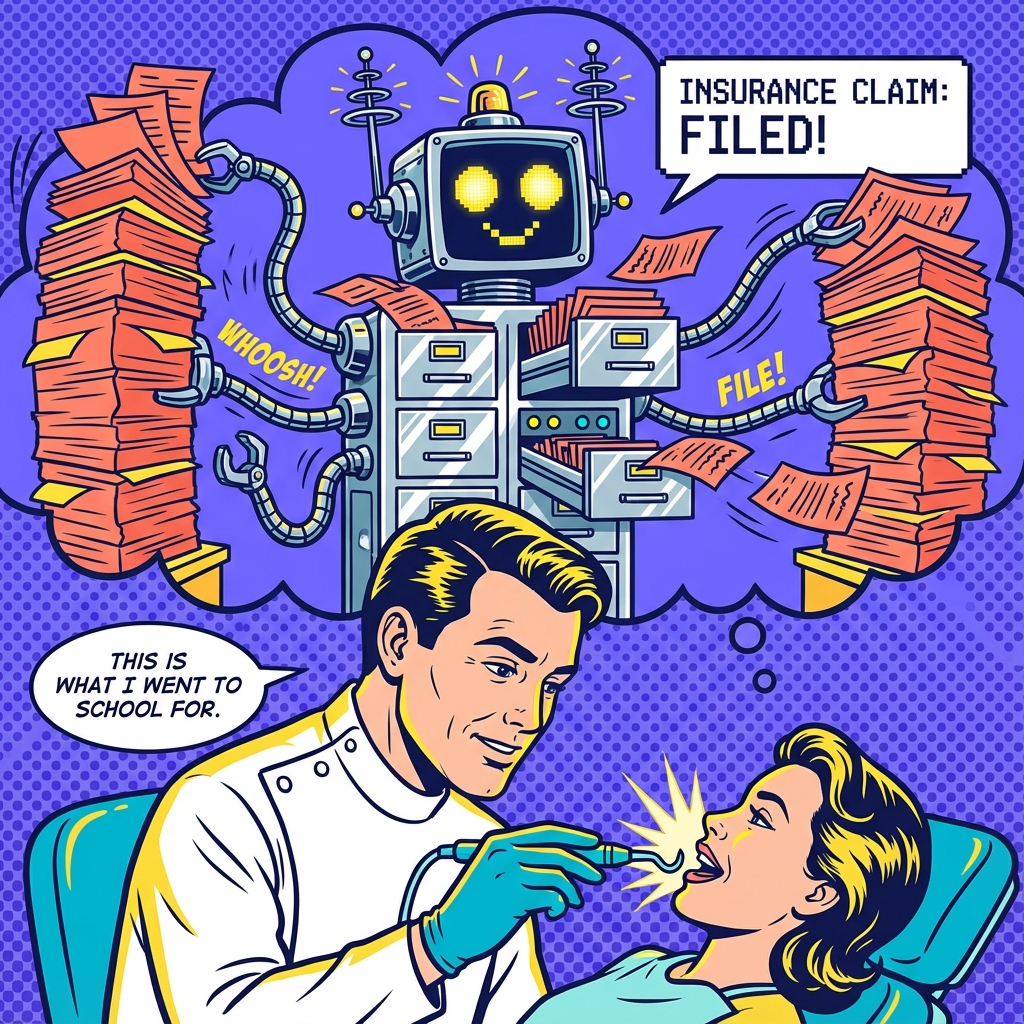
The Boring Stuff: Scheduling, insurance verification, claim submissions. AI handles it. You don't miss it.
AI Across Your Practice
Beyond chairside, AI is handling the business side:
- Front desk: 24/7 scheduling, insurance verification, automated recall systems
- Billing: Claim denial predictions, auto-appeals, coding assistance
- Research: Literature summaries, personalized CE recommendations
- Operations: No-show predictions, inventory management, revenue forecasting
The net effect? Less "running a small business" headache, more actual dentistry. (Bioengineering Review, 2025)
Where Humans Still Win:
- Every. Single. Procedure. Drilling, filling, extracting, implanting—all require your hands.
- Clinical judgment - That "something's off here" intuition that comes from experience
- Patient relationships - Managing dental anxiety is an art, not an algorithm
- Legal accountability - You're on the hook regardless of what AI suggests (more on this in a moment)
The Tasks Table: Robot vs Human
| Task | AI | Human | Winner |
|---|---|---|---|
| Spotting caries on X-rays | 85-91% accurate | Adds clinical context | Tie |
| Periodontal assessment | 88-95% accurate | Treatment planning | Tie |
| Chart documentation | Saves ~10% time | Clinical nuance | AI |
| Insurance/billing | Handles 90% | Complex exceptions | AI |
| Calming anxious patients | Useless | Essential | Human |
| Actual procedures | Can't hold a drill | Your whole job | Human |
| Treatment planning | Suggests options | Weighs patient values | Human |
| Emergency decisions | Too slow | Real-time judgment | Human |
The Bottom Line
Yes, AI will automate radiograph analysis, documentation, and admin tasks. No, AI won't replace the dentist who calms anxious patients, makes judgment calls, and actually performs procedures.
The dentists who thrive will be:
- AI-augmented - Using tools to catch what they might miss
- Freed from paperwork - Actually going home on time
- Relationship-focused - Investing saved time in patients
- Clinically sharp - Handling the complex cases AI can't
- Adaptable - Learning new tools without fear
Your move: Research one AI diagnostic tool this week. The dentists who struggle won't be replaced by robots—they'll burn out from paperwork while their colleagues use AI to actually practice dentistry.
What's Next?
Ready to future-proof your career? Our AI Adaptation Guide covers the skills and strategies that matter across every profession—from embracing AI tools to doubling down on uniquely human strengths.
Sources & Further Reading
This article gives you the overview. For the full methodology, raw data, and peer-reviewed details, here are the authoritative sources we drew from:
Peer-Reviewed Research:
- Ibraheem et al. (2025) - The diagnostic accuracy study behind the 91%/87% sensitivity/specificity numbers. Full methodology and statistical analysis. Read on PMC
- Bioengineering Review (2025) - Comprehensive review of AI innovations, ethical considerations, and integration barriers in dentistry. Read on PMC
- PMC Systematic Review (2025) - Meta-analysis of AI tools across multiple studies, pooled accuracy data. Read on PMC
- Teledentistry Review (2025) - AI-enhanced teledentistry and hybrid care models for underserved populations. Read on PMC
Regulatory & Professional Standards:
- NHS England (2025) - Official guidance on AI scribes as medical devices, legal responsibility framework. British Dental Journal
- Oral Health Group (2025) - Risk-based framework for dental AI adoption, regulatory classification. Read article
- ANSI/ADA Standard No. 1110-1:2025 - First U.S. standard on AI validation datasets in dentistry (focuses on data quality and annotation, not risk classification)
Clinical Trials:
- UCLA Health (2025) - RCT comparing AI scribes (Microsoft DAX and Nabla) vs usual care across 238 physicians. Nabla reduced documentation time by ~10% (41 seconds per note). Read study
Industry Data:
- Overjet (2024) - Clinical outcomes data, case acceptance improvements. TIME Best Inventions
- Inside Dentistry (2024) - U.S. adoption survey: 18% adopted, 47% considering
- Dentaly (2023) - Earlier adoption benchmark: ~35% of U.S. dentists
If you're presenting to your practice partners or want to verify any specific claim, these sources have the detailed data.
Last Updated: December 2025