Digital Marketer
Can AI replace digital marketers? At 60% risk, technical execution is commoditizing fast. But channel strategy and knowing when to override the algorithm? Still human.
AI can optimize your SEO, manage your PPC bids, and personalize your emails automatically. But deciding which channels deserve investment, interpreting conflicting attribution data, and knowing when to break the rules? That's where humans still win.
Can AI Take My Digital Marketing Job?
You've watched Google's Performance Max campaigns run themselves, seen AI write ad copy that outperforms your team's, and wondered how long until the algorithm doesn't need you at all. When AI can optimize bids, generate content, and target audiences better than humans, what's left? Here's what's actually happening.
We've Been Here Before: Automation Didn't Kill Digital Marketers
In the 2010s, automated bidding was going to eliminate PPC specialists. Then programmatic was going to replace media buyers. Then marketing automation would make email marketers obsolete.
Digital marketing roles have grown consistently, and specialists who master AI tools remain in demand. The platforms got smarter, but someone still needs to tell them what "success" means.
Why? Because companies don't pay for optimized clicks. They pay for:
- Understanding which metrics actually matter for the business
- Knowing when to trust the algorithm and when to override it
- Seeing opportunities the AI hasn't been trained to find
- Connecting digital performance to real business outcomes
- Fixing things when automation breaks (and it always breaks)
- Explaining technical results to non-technical stakeholders
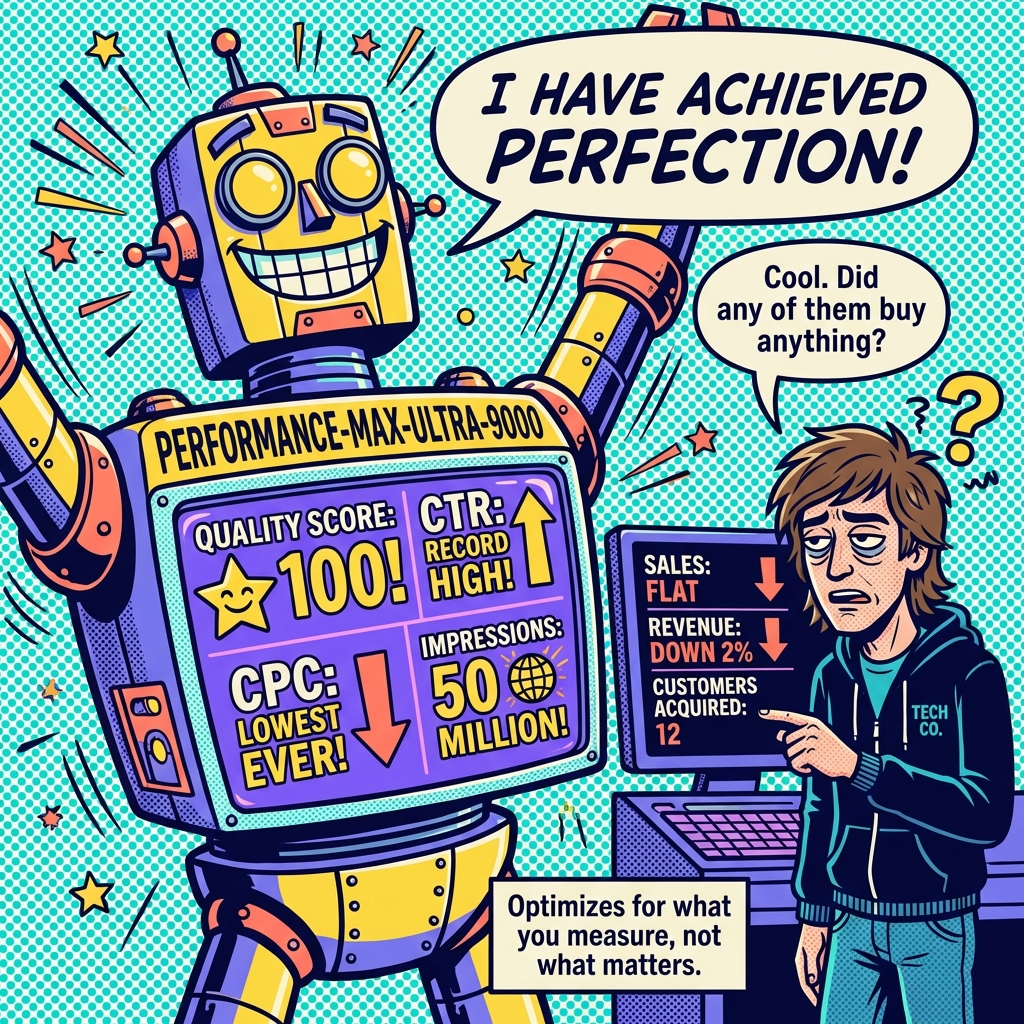
AI can optimize your Quality Score to perfection. It can't explain to the CMO why branded search shouldn't count toward new customer acquisition.
What AI Can Actually Do Today
Tasks AI Wins At:
- PPC bid management - Real-time optimization across thousands of keywords
- SEO technical audits - Crawling, indexing issues, site speed analysis
- Email personalization - Dynamic content, send time optimization, subject line testing
- Ad creative generation - Headlines, descriptions, image variations
- Audience targeting - Lookalike modeling, behavioral segmentation, predictive scoring
- Reporting automation - Dashboard updates, anomaly detection, performance summaries
What Humans Still Dominate:
- Channel strategy - Where to invest, when to expand, what to cut
- Creative direction - The big idea behind campaigns, brand consistency
- Attribution interpretation - Making sense of conflicting data models
- Competitive response - Adapting when competitors change the game
- Stakeholder translation - Turning data into decisions for leadership
- Innovation testing - Finding new channels, tactics, and approaches
The Tasks Table: Robot vs Human
These are directional estimates based on current capabilities—not scientific measurements. Your mileage will vary by company, industry, and budget.
| Task | AI Capability | Human Advantage | Winner |
|---|---|---|---|
| PPC bid optimization | 90% | 10% - business context | AI |
| SEO technical fixes | 85% | 15% - prioritization | AI |
| Email A/B testing | 85% | 15% - test design | AI |
| Ad copy generation | 75% | 25% - brand voice | Tie |
| Landing page testing | 70% | 30% - UX judgment | Tie |
| Keyword research | 65% | 35% - intent understanding | Tie |
| Channel strategy | 35% | 65% - business alignment | Human |
| Creative direction | 25% | 75% - brand vision | Human |
| Attribution analysis | 40% | 60% - business judgment | Human |
| Vendor management | 15% | 85% - relationships | Human |
| Cross-channel planning | 30% | 70% - holistic thinking | Human |
Risk by Experience Level
Digital marketing risk varies dramatically by seniority:
Entry-Level Digital Marketers (75% Risk)
Highest risk in marketing. When AI handles campaign setup, basic optimization, and reporting, companies need fewer coordinators and specialists doing tactical work.
What's disappearing:
- Campaign setup and management roles
- Basic SEO specialist positions
- Entry-level PPC roles
- Manual reporting tasks
Your move: Skip the execution treadmill—demonstrate strategic thinking and AI tool mastery from day one.
Mid-Level Digital Marketers (60% Risk)
The squeeze zone. You're expected to both execute and strategize. AI handles more of the former, making the latter your differentiator.
What's changing:
- Fewer execution responsibilities
- Higher strategy expectations
- Tool expertise becomes mandatory
- Cross-channel thinking required
Your move: Become the person who knows when the algorithm is wrong—that judgment is increasingly rare.
Senior Digital Marketers (40% Risk)
Strategy-protected. The channel strategy, budget allocation, and stakeholder management that define senior roles resist automation.
What's changing:
- Smaller teams, broader scope
- AI fluency expected
- More pressure to connect to revenue
- Innovation expectations rising
Your move: Position yourself as the strategist who uses AI to move faster—not the tactician AI is replacing.
The AI Tools Reshaping Digital Marketing
SEO & Content:
- SEMrush and Ahrefs use AI for keyword difficulty, content gaps, and technical audits
- Surfer SEO and Clearscope optimize content in real-time
- AI content tools generate first drafts at scale
Paid Media:
- Google Performance Max runs campaigns with minimal human input
- Meta Advantage+ automates audience targeting and creative testing
- AI bidding outperforms manual management in most cases
Email & CRM:
- Platforms predict optimal send times per subscriber
- Dynamic content personalizes at scale
- AI writes subject lines that outperform human-written ones
Analytics:
- Google Analytics 4's machine learning surfaces insights automatically
- Attribution AI models allocate credit across touchpoints
- Anomaly detection catches problems before you do
The digital marketers who thrive use these tools to move faster—and spend their time on what AI can't do.
The Counter-Narrative: Technical Commoditization Elevates Strategy
Here's what the doom narratives miss:
More automation means competitive advantage shifts to strategy Better targeting means brand differentiation matters more Cheaper execution means more companies invest in digital Faster optimization means creative quality becomes the bottleneck
Research from the World Economic Forum indicates that while AI will displace some roles, it will also create new opportunities—with a net gain of 78 million jobs projected by 2030 (WEF, 2025). The key is that productivity gains go toward strategic work, not replacement.
The real transformation:
- Technical execution becomes table stakes
- Strategic thinking becomes the premium skill
- Tool literacy separates good from great
- The "T-shaped" marketer (broad + deep) wins
The Bottom Line
Yes, AI will automate bid management, content optimization, and campaign reporting. No, AI won't replace the digital marketer who understands how channels work together, when to break best practices, and how to connect marketing performance to business outcomes.
The digital marketers who thrive will be:
- Strategically oriented (selling outcomes, not tactics)
- AI-augmented (using automation for execution leverage)
- Business-connected (speaking revenue, not just ROAS)
- Adaptable (finding new channels and opportunities)
Your move: This week, let Google's Performance Max run a campaign you've been managing manually. Study where it succeeds and where it fails. The digital marketers who struggle won't be replaced by AI—they'll be outperformed by digital marketers who know when to trust algorithms and when to override them.
What's Next?
Ready to future-proof your career? Our AI Adaptation Guide covers the skills and strategies that matter across every profession—from embracing AI tools to doubling down on uniquely human strengths.
Sources & Further Reading
Industry Research:
- SurveyMonkey (2025) - AI in Marketing Statistics - 73% say AI plays a key role in personalized customer experience; 51% use AI to optimize content for SEO and email
- Demand Gen Report (2025) - AI Agents in B2B Marketing - AI agents moving from automation to strategy
Labor Market Analysis:
- World Economic Forum Future of Jobs Report 2025 - Press release - By 2030: 170 million new roles created, 92 million displaced, net gain of 78 million jobs
Platform & Tool Documentation:
- Google Performance Max - Automated campaign management across Google inventory
- SEMrush, Ahrefs - AI-powered SEO and competitive intelligence
- Meta Advantage+ - Automated audience and creative optimization
Last Updated: January 2026