Doctor
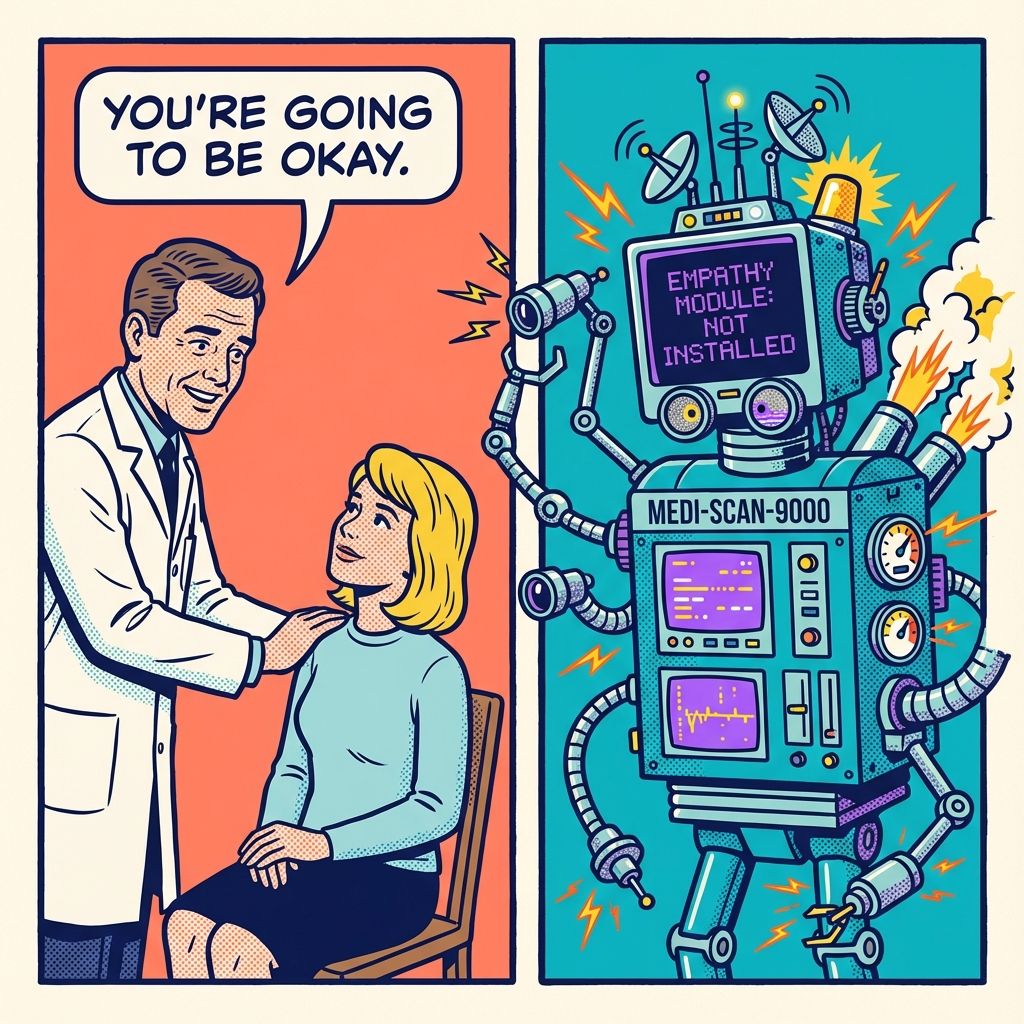
Can AI replace doctors? At 25% risk, probably not. Clerical work is automating — but the doctor who holds your hand during a scary diagnosis? Irreplaceable.
Your clerical work is being automated, not your clinical judgment. The doctors who win will spend less time typing and more time healing.
Can Robots Take My Medical Job?
You're here because you saw another headline about AI diagnosing diseases faster than doctors, and you wondered if those 12 years of training were about to become obsolete. Here's what's actually happening.
We've Been Here Before: Technology Enhanced Medicine, Not Replaced It
In the 1800s, the stethoscope was going to make physical examination obsolete. Then X-rays would replace doctors entirely. Then the internet would let patients diagnose themselves.
There are MORE doctors today than ever before, and demand keeps growing.
Why? Because patients don't pay doctors for information. They pay for:
- Clinical judgment in ambiguous situations
- Someone to take responsibility for decisions
- The therapeutic relationship
- Procedures and physical interventions
- "Is this serious?" conversations
- Trust and reassurance
AI can provide information. It can't hold your hand during a scary diagnosis.
What AI Can Actually Do Today
Tasks AI Wins At:
- Medical imaging analysis - Detecting patterns in X-rays, MRIs, pathology slides
- Clinical documentation - Ambient scribes that write chart notes from conversations
- Drug interaction checking - Faster and more comprehensive than humans
- Administrative tasks - Scheduling, prior authorizations, billing codes
- Literature review - Synthesizing research across thousands of papers
What Humans Still Dominate:
- Clinical judgment - Integrating symptoms, history, and intuition
- Patient relationships - Trust, empathy, and therapeutic alliance
- Physical examination - Hands-on assessment that AI can't perform
- Complex decision-making - Weighing trade-offs with patient values
- Procedures - Surgery, deliveries, emergency interventions
- Medical-legal responsibility - Someone must sign and be accountable
The Tasks Table: Robot vs Human
| Task | AI Capability | Human Advantage | Winner |
|---|---|---|---|
| Chart documentation | 85% | 15% - clinical nuance | AI |
| Image interpretation | 80% | 20% - clinical context | Tie |
| Drug interaction alerts | 95% | 5% - judgment on relevance | AI |
| Patient communication | 30% | 70% - empathy, trust | Human |
| Physical examination | 5% | 95% - hands-on assessment | Human |
| Surgical procedures | 10% | 90% - dexterity, judgment | Human |
| Differential diagnosis | 60% | 40% - pattern recognition | Tie |
| End-of-life conversations | 5% | 95% - humanity required | Human |
| Treatment planning | 40% | 60% - patient values | Human |
The Counter-Narrative: AI Saves Doctors From Burnout
Here's the surprising reality:
40% of physicians experience burnout 69% of their time is spent on clerical tasks 2 hours of paperwork for every 1 hour with patients
AI isn't replacing doctors—it's rescuing them from administrative hell.
The real transformation:
- AI scribes eliminate charting burden
- Automated prior authorizations save hours weekly
- AI-assisted diagnosis speeds up routine cases
- More time for complex patients who need you
The Bottom Line
Yes, AI will automate medical documentation and assist with diagnostics. No, AI won't replace the doctor who holds a patient's hand and explains what's happening.
The doctors who thrive will be:
- AI-augmented (using tools to eliminate paperwork)
- Relationship-focused (investing saved time in patients)
- Clinically excellent (handling the complex cases AI can't)
- Adaptable (learning new tools as they emerge)
Your move: Try an AI scribe this week. The doctors who struggle won't be replaced by robots—they'll burn out from paperwork while their colleagues use AI to actually practice medicine.
What's Next?
Ready to future-proof your career? Our AI Adaptation Guide covers the skills and strategies that matter across every profession—from embracing AI tools to doubling down on uniquely human strengths.