Junior Developer
Can AI replace junior developers? At 75% risk, entry-level coding jobs are down 60% since 2022. The traditional path is breaking — here's what's actually working instead.
The traditional 'learn to code, get hired' pipeline is breaking. Entry-level developer jobs are shrinking faster than any other tech role. Success now requires differentiation beyond coding skills.
Can Robots Take My Junior Developer Job?
If you're a bootcamp grad, CS graduate, or career switcher trying to break into tech, you're not imagining it: the entry-level developer job market has fundamentally changed. Here's what the data shows—and more importantly, what you can do about it.
The Honest Truth: This Isn't the Market You Prepared For
Let's be direct: the junior developer role—as it existed from 2015-2021—is disappearing.
The data from multiple sources tells the same story:
- Entry-level tech job postings are down 60% since 2022
- Microsoft reports 40% of its recent layoffs affected developers, with junior roles hit hardest
- AI coding tools are now writing 30% of new code at major companies
- Companies that hired 10 juniors in 2021 are hiring 2-3 in 2025
What changed? AI coding assistants can now do much of what companies hired juniors to do:
- Write boilerplate code
- Implement well-defined features
- Fix simple bugs
- Generate documentation and tests
A senior engineer with Copilot can now do what used to require a senior plus two juniors.
Why Companies Are Hiring Fewer Juniors
The Economic Math
Before AI tools (2019-2021):
- Senior engineer: $180,000/year
- 2 junior engineers: $140,000/year ($70K each)
- Total: $320,000 for team output X
After AI tools (2024-2025):
- Senior engineer: $200,000/year
- AI tools: $500-2,000/year
- Total: ~$202,000 for team output X (or greater)
The ROI on junior developers—as a labor arbitrage play—no longer works when AI provides cheaper leverage.
The Pipeline Problem
Here's what companies haven't figured out: if nobody hires juniors, where do future seniors come from?
This is creating an industry-wide talent development crisis. But that's a problem for 2030. Hiring managers are solving for 2025 budgets.
Not Everyone Agrees: IBM Is Tripling Junior Hiring
In February 2026, IBM announced it's tripling entry-level US developer hiring — the loudest counter-signal to the "juniors are dead" narrative (Bloomberg, February 2026).
IBM's reasoning: cut juniors now, face a crippling talent gap in 3-5 years when you need mid-level engineers and they don't exist. External hiring to fill senior gaps costs more than building the pipeline internally.
But here's the twist — IBM's junior roles look different from what you'd expect:
- Less: Writing boilerplate code, implementing standard features
- More: Client-facing communication, translating requirements between technical and non-technical teams, reviewing and validating AI-generated output
The role isn't disappearing uniformly. It's restructuring. Some companies are cutting juniors entirely. Others like IBM are betting that investing in a new kind of junior — one who evaluates AI output rather than competes with it — will pay off within 3-5 years.
Risk Varies by What You Actually Do
Your risk as a junior developer depends enormously on the type of work you do:
| Sub-Role | Risk Level | Direction | Why |
|---|---|---|---|
| Pure implementation (boilerplate, CRUD) | HIGH | Increasing | This is AI's sweet spot |
| AI-native generalist (leverages AI across tasks) | MODERATE | Stable | Can accelerate legacy team modernization |
| Client-facing technical (requirements, explanation) | MODERATE-LOW | Growing | IBM model — communication + technical skills |
| Specification and judgment work | LOW | New role | Structurally resistant to automation |
What AI Can Do Today (The Junior Developer Overlap)
Tasks AI Handles Well:
- CRUD operations - Standard database interactions
- Boilerplate code - Repetitive patterns and scaffolding
- Simple features - Well-defined implementations with clear specs
- Test generation - Unit tests from existing code
- Documentation - README files, code comments
- Bug fixes - Simple, well-defined issues
- Code translation - Converting between languages
What AI Still Struggles With:
- Ambiguous requirements - "Make it better" type requests
- Cross-system debugging - Issues spanning multiple services
- Business context - Understanding why something should be built
- User empathy - Knowing what users actually need
- Novel problem-solving - Situations without clear patterns
The problem for juniors: The "AI struggles" list is exactly what companies traditionally trained juniors to do over 2-3 years. Now companies aren't willing to wait.
The Tasks Table: Robot vs Junior Developer
| Task | AI Capability | Junior Developer | Winner |
|---|---|---|---|
| Boilerplate code | 95% | 5% - context awareness | AI |
| Simple bug fixes | 85% | 15% - root cause thinking | AI |
| Documentation | 90% | 10% - accuracy checks | AI |
| Test generation | 80% | 20% - edge case identification | AI |
| Feature implementation | 70% | 30% - requirements clarification | AI |
| Code review (receiving) | N/A | Learning opportunity | Draw |
| Debugging complex issues | 30% | 70% - learning required | Human |
| Understanding business context | 15% | 85% - exposure dependent | Human |
| Cross-team communication | 10% | 90% - relationship building | Human |
The uncomfortable truth: AI wins in exactly the tasks that defined the junior developer role.
The Alternative Paths
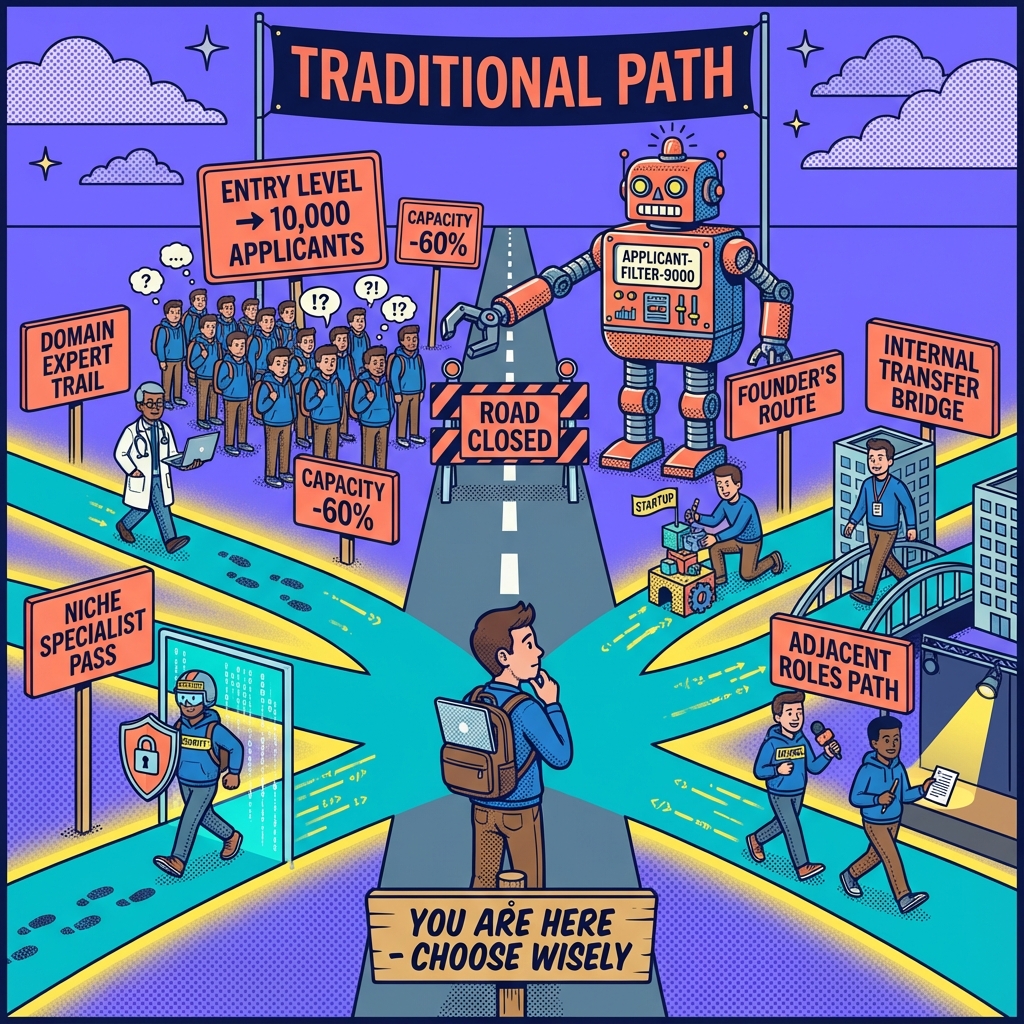
The traditional path—bootcamp/degree → applications → junior role → growth—is becoming less reliable. Here are alternatives that are working in 2025:
Path 1: The Domain Expert Route
Instead of: "I can code" Lead with: "I understand [industry] AND I can code"
- Healthcare workers learning health tech
- Finance professionals adding Python
- Teachers building EdTech
- Anyone with 5+ years in an industry adding technical skills
Why it works: Domain expertise takes years to develop. Coding can be learned. The combination is rare.
Path 2: The Internal Transfer
Instead of: Breaking in from outside Lead with: "I already work here, I want to move to engineering"
- Operations → Developer
- Support → Developer
- QA → Developer
- Any role → Technical role
Why it works: You understand the business, you're a known quantity, you have relationships. Companies prefer promoting internally over external junior hires.
Path 3: The Niche Specialist
Instead of: "Full-stack developer" Lead with: "I specialize in [specific technology]"
- Kubernetes and infrastructure
- Security and pen testing
- Embedded systems and IoT
- Game development (specific engines)
- ML/AI engineering (yes, AI can create AI jobs too)
Why it works: Generalists are abundant. Specialists are scarce.
Path 4: The Founder Route
Instead of: Working for someone else Lead with: Build something yourself
- Solo SaaS projects
- Freelance development (start with small projects)
- Technical co-founder for non-technical founders
- Open source contributions leading to opportunities
Why it works: You're not competing for the shrinking job pool. You're creating your own opportunity.
Path 5: The Adjacent Role
Instead of: Developer Lead with: Technical but not pure coding
- Developer Relations
- Technical Writing
- QA Engineering
- Product Management (with technical background)
- Technical Support (as stepping stone)
Why it works: These roles still value technical skills but compete in different pools.
The Skills That Still Matter
What to Prioritize:
- System thinking - Understanding how pieces connect
- Communication - Translating between technical and non-technical
- Debugging methodology - Not just fixing bugs, but systematic approaches
- Business context - Why does this feature matter to the business?
- AI-assisted development - Using AI tools effectively, not avoiding them
What to Deprioritize:
- Algorithm memorization - AI handles this better
- Boilerplate speed - AI handles this better
- Multiple language mastery - Depth > breadth
- Tutorial completion - Doing > watching
The New Apprenticeship: Learning by Watching AI
Here's a counterintuitive development from March 2026: experienced engineers report that watching autonomous AI agents build software teaches them more about software engineering than writing code themselves (Eno Reyes, Factory AI co-founder).
This inverts the traditional learning path. Instead of learn → build → get feedback, the new model is:
- Watch AI build software — observe how it structures code, makes architectural choices, handles edge cases
- Notice where it makes good and bad decisions — develop pattern recognition
- Build evaluation judgment through observation — learn what "good" looks like at volume
- Direct future builds — apply that judgment to specify and evaluate AI output
As of March 2026, this path is emerging but unproven at scale. But for junior developers struggling to get traditional apprenticeship experience (mentorship from senior engineers), watching and evaluating AI output may be the closest available substitute. The engineers who develop strong evaluation judgment — knowing when AI code is solid and when it's a time bomb — will be the ones who advance.
The Bottom Line
The junior developer job market has structurally changed. This isn't a cycle—it's a shift.
The bad news: Traditional entry paths are closing. "Learn to code, get hired" is no longer a reliable strategy.
The good news: Paths still exist for those willing to differentiate. Domain expertise, niche skills, internal transfers, and entrepreneurship are working where mass applications are failing.
The honest assessment: If you're currently job-searching with a generalist junior profile and no differentiation, you're competing against thousands of similar candidates for a shrinking number of roles. The math doesn't work.
Your move: Stop competing on the same axis as everyone else. Pick a path that uses your unique background, build proof of work, and execute. The developers who break in from here will be the ones who found an angle.
What's Next?
Ready to future-proof your career? Our AI Adaptation Guide covers the skills and strategies that matter across every profession—from embracing AI tools to doubling down on uniquely human strengths.