Marketer
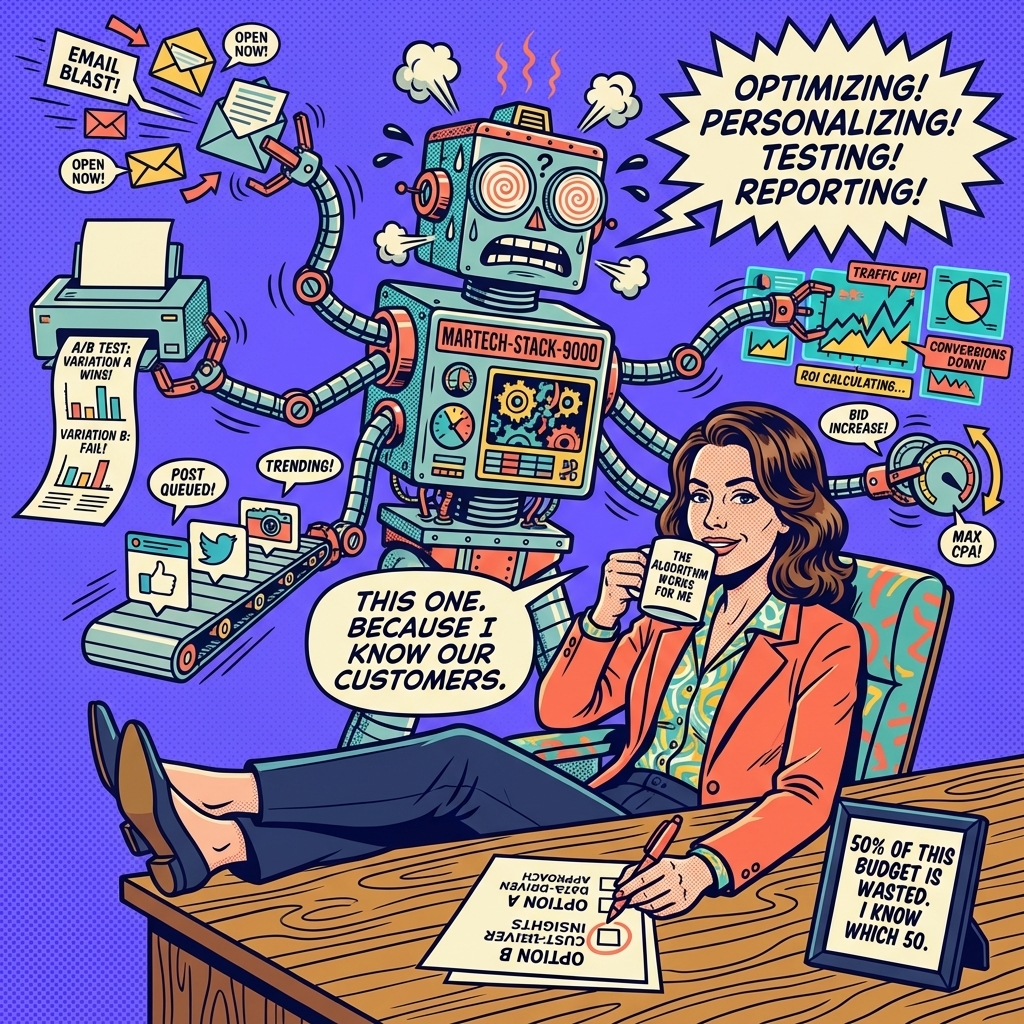
Can AI replace marketers? At 50% risk, execution is automating fast. But knowing which campaign deserves the budget? That's still human territory.
AI can optimize campaigns, generate reports, and A/B test everything automatically. But allocating budget across channels, managing stakeholder expectations, and knowing when data is lying? That requires human judgment that algorithms can't replicate.
Can AI Take My Marketing Job?
You've watched AI tools promise to automate your entire marketing stack, and you're wondering if your role is next. When platforms can optimize bids, personalize emails, and generate content automatically, what exactly are marketers for? Here's what's actually happening.
We've Been Here Before: MarTech Didn't Replace Marketers
In the 2010s, marketing automation platforms were going to make marketers obsolete. Then programmatic advertising. Then attribution software that would "prove" exactly what worked.
The U.S. Bureau of Labor Statistics projects employment for advertising, promotions, and marketing managers will grow 6% from 2024 to 2034—indicating continued demand for marketing leadership even as the tooling transforms (BLS, 2024). The tools got smarter, but companies still need someone to decide what to do with them.
Why? Because companies don't pay for optimized campaigns. They pay for:
- Knowing which 50% of the budget is wasted (and doing something about it)
- Translating business goals into marketing strategy
- Managing agencies, vendors, and internal teams
- Making judgment calls when the data is inconclusive
- Taking responsibility when campaigns fail
- Building the relationships that get marketing a seat at the table
AI can run 1,000 A/B tests simultaneously. It can't explain to the CEO why brand investment matters when the CFO wants everything tied to last-click attribution.
What AI Can Actually Do Today
Tasks AI Wins At:
- Campaign optimization - Real-time bid adjustments, budget allocation suggestions
- Reporting and dashboards - Automated performance summaries, anomaly detection
- A/B testing at scale - Multivariate testing across thousands of variations
- Content generation - Ad copy, email variations, social posts
- Audience segmentation - Behavioral clustering, lookalike modeling
- Predictive analytics - Forecasting campaign performance, churn prediction
What Humans Still Dominate:
- Budget allocation decisions - Balancing short-term ROI vs long-term brand building
- Stakeholder management - Getting buy-in, managing expectations, navigating politics
- Agency relationships - Vendor selection, performance management, negotiation
- Crisis response - When campaigns backfire or markets shift suddenly
- Strategic prioritization - Which opportunities to pursue, which to ignore
- Team development - Growing talent, managing performance, building culture
The Tasks Table: Robot vs Human
These are directional estimates based on current capabilities—not scientific measurements. Your mileage will vary by company, industry, and budget.
| Task | AI Capability | Human Advantage | Winner |
|---|---|---|---|
| Campaign optimization | 85% | 15% - knowing when to override | AI |
| Performance reporting | 80% | 20% - narrative and context | AI |
| A/B testing | 90% | 10% - test design and interpretation | AI |
| Content generation | 70% | 30% - brand voice and strategy | Tie |
| Audience targeting | 75% | 25% - customer intuition | Tie |
| Budget allocation | 40% | 60% - business context and politics | Human |
| Stakeholder communication | 15% | 85% - relationships and persuasion | Human |
| Team leadership | 10% | 90% - motivation and development | Human |
| Strategic planning | 25% | 75% - vision and judgment | Human |
| Crisis management | 20% | 80% - judgment under pressure | Human |
Risk by Experience Level
Not all marketers face the same risk. Your experience level dramatically changes your exposure:
Entry-Level Marketers (65% Risk)
Most vulnerable. When AI can handle campaign setup, basic reporting, and content generation, companies need fewer coordinators and assistants. The traditional "learn by doing grunt work" path is shrinking.
What's changing:
- Fewer entry-level campaign management roles
- Content creation becoming AI-assisted from day one
- Basic analytics automated out of existence
Your move: Demonstrate strategic thinking and AI fluency immediately—pure execution skills aren't enough to get hired.
Mid-Level Marketers (50% Risk)
Transitional zone. You're expected to manage campaigns and contribute to strategy. AI handles more of the former, which means the latter becomes your differentiator.
What's changing:
- Execution responsibilities shrinking
- Strategy expectations rising faster
- Tool expertise becoming table stakes
Your move: Shift from "doing marketing" to "orchestrating marketing"—use AI to execute while you focus on judgment calls.
Senior Marketers & Directors (35% Risk)
Relatively protected. The strategic decisions, stakeholder management, and organizational navigation that define senior roles resist automation.
What's changing:
- Smaller teams, same scope (AI multiplies individual output)
- Higher expectations for AI fluency
- More pressure to justify marketing investments
Your move: Become the person who knows when to trust AI and when to override it—that judgment is increasingly valuable.
AI Across Your Marketing Function
It's not just your campaigns. AI is transforming the entire marketing operation:
Campaign Management:
- AI optimizes bids and budgets in real-time
- Automated creative testing across channels
- Dynamic audience targeting adjustments
Analytics & Reporting:
- Dashboards update automatically
- Anomaly detection alerts you to problems
- Attribution modeling runs continuously
Content Operations:
- AI generates ad copy variations
- Email personalization at scale
- Social content calendars populated automatically
Market Research:
- Competitive intelligence monitoring
- Sentiment analysis across channels
- Trend prediction and opportunity identification
The marketers who thrive use these tools to move faster, not to be replaced by them.
The Counter-Narrative: AI Makes Marketers More Valuable
Here's what the "AI will replace marketing" articles miss:
More channels means more complexity to orchestrate Faster execution means strategic mistakes happen faster too More data means more need for judgment about what matters Automated optimization means competitive advantage shifts to strategy
McKinsey's annual State of AI survey shows that while AI adoption is accelerating, most organizations are still early in scaling AI into core workflows—suggesting the "AI replaces everyone" timeline is further out than headlines suggest (McKinsey, 2025).
The real transformation:
- Marketers become orchestrators, not executors
- Tactical skills depreciate, strategic skills appreciate
- Tool literacy becomes table stakes, judgment becomes premium
- The gap between good and great marketers widens
The Bottom Line
Yes, AI will automate campaign optimization, reporting, and content generation. No, AI won't replace the marketer who knows which battles to fight, which stakeholders to manage, and when the data is misleading.
The marketers who thrive will be:
- AI-fluent (using tools to execute 10x faster)
- Strategy-focused (selling thinking, not tactics)
- Politically savvy (navigating organizations, not just dashboards)
- Accountability-embracing (owning outcomes, not just activities)
Your move: Spend 30 minutes this week with an AI marketing tool you haven't tried yet. The marketers who struggle won't be replaced by AI—they'll be outperformed by marketers who use AI to deliver better results faster.
What's Next?
Ready to future-proof your career? Our AI Adaptation Guide covers the skills and strategies that matter across every profession—from embracing AI tools to doubling down on uniquely human strengths.
Sources & Further Reading
Labor Market Data:
- U.S. Bureau of Labor Statistics (2024) - Occupational Outlook: Advertising, Promotions, and Marketing Managers - Projects 6% employment growth from 2024 to 2034
Industry Research:
- Digital Marketing Institute (2025) - AI Marketing Stats - 92% of businesses plan to invest in generative AI within 3 years; 75% of companies using AI for marketing will shift to more strategic activities
- McKinsey State of AI (2025) - Annual global survey - Tracks AI adoption and scaling challenges across industries
Market Analysis:
- World Economic Forum Future of Jobs Report 2025 - Press release - By 2030: 170 million new roles created, 92 million displaced, net gain of 78 million jobs; disruption affects 22% of jobs
Last Updated: January 2026