Nurse
Can AI replace nurses? At 25% risk, probably not. AI handles charting — you handle the human moments that actually save lives. See the full risk analysis.
AI will handle documentation and monitoring, but the human connection at the bedside is irreplaceable. The nurses who win will spend less time charting and more time caring.
Can Robots Take My Nursing Job?
You're here because you saw another headline about AI diagnosing patients and robots delivering medications, and you wondered if nursing school was a mistake. Here's what's actually happening.
We've Been Here Before: Technology Made Nursing More Human, Not Less
In the 1960s, ICU monitoring was going to eliminate bedside nursing. Then computerized charting. Then telehealth during COVID.
Nursing is projected to add 177,400 jobs by 2032—one of the fastest-growing occupations in America.
Why? Because patients don't pay for vital signs. They pay for:
- Someone who notices the subtle change before the alarm goes off
- A reassuring presence during their most vulnerable moments
- Advocacy when something doesn't feel right
- Physical care that requires human touch
- The judgment call at 3 AM
- Someone who sees them as a person, not a patient
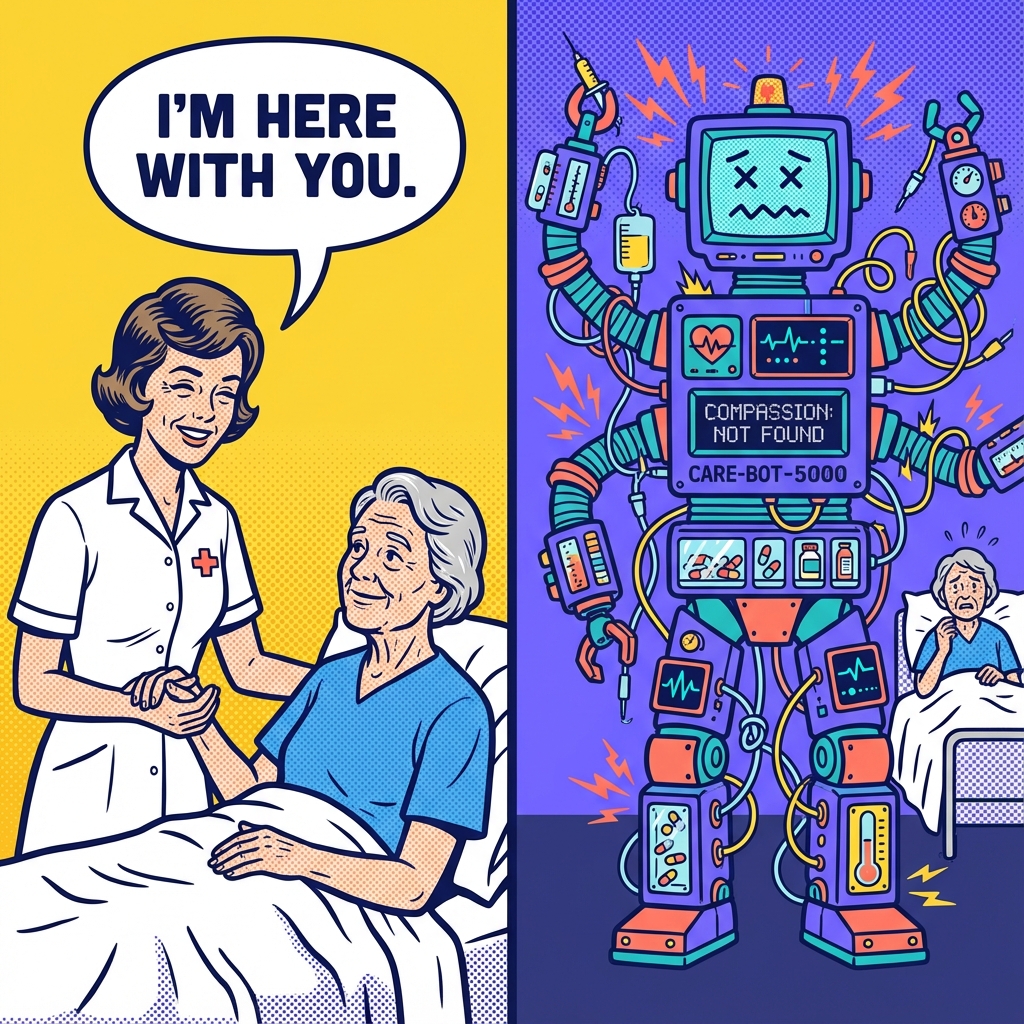
AI can monitor heart rhythms. It can't hold a hand during a scary diagnosis.
What AI Can Actually Do Today
Tasks AI Wins At:
- Vital sign monitoring - Continuous, never tired (95%+ accuracy)
- Documentation - AI scribes writing notes from conversations
- Medication reminders - Automated alerts and verification
- Scheduling - Optimizing patient assignments
- Pattern recognition - Flagging concerning trends in data
What Humans Still Dominate:
- Clinical intuition - "Something's not right" before data shows it
- Physical assessment - Touch, observation, clinical exam
- Patient advocacy - Speaking up when care plans need adjustment
- Emotional support - Comfort, reassurance, human presence
- Complex care coordination - Juggling multiple patients, priorities, emergencies
- Family communication - Explaining, supporting, preparing for hard news
The Tasks Table: Robot vs Human
| Task | AI Capability | Human Advantage | Winner |
|---|---|---|---|
| Vital sign monitoring | 95% | 5% - context interpretation | AI |
| Documentation | 80% | 20% - clinical nuance | AI |
| Medication verification | 85% | 15% - patient-specific judgment | Tie |
| Patient assessment | 40% | 60% - physical exam + intuition | Human |
| Emotional support | 10% | 90% - genuine human connection | Human |
| Emergency response | 25% | 75% - rapid judgment + action | Human |
| Patient advocacy | 5% | 95% - relationships + judgment | Human |
| Family communication | 15% | 85% - empathy + explanation | Human |
| Care coordination | 30% | 70% - prioritization + judgment | Human |
The Counter-Narrative: AI Rescues Nurses From Burnout
Here's the surprising reality:
62% of nurses report burnout 40% of their time goes to documentation Nursing shortage: 78,000 unfilled positions
AI isn't replacing nurses—it's the only thing that might save the profession from collapse.
The real transformation:
- AI documentation gives time back to patients
- Smart monitoring reduces alarm fatigue
- Automated scheduling improves work-life balance
- AI assistance makes the job sustainable
The Bottom Line
Yes, AI will automate vital sign monitoring and documentation. No, AI won't replace the nurse who notices something's wrong before the monitors do.
The nurses who thrive will be:
- AI-augmented (using tools to eliminate paperwork)
- Patient-focused (investing saved time in bedside care)
- Clinically sharp (handling complex cases AI can't)
- Emotionally present (providing the human connection patients need)
Your move: Ask about AI documentation tools at your next shift. The nurses who struggle won't be replaced by robots—they'll burn out from charting while their colleagues use AI to actually nurse.
What's Next?
Ready to future-proof your career? Our AI Adaptation Guide covers the skills and strategies that matter across every profession—from embracing AI tools to doubling down on uniquely human strengths.