Truck Driver
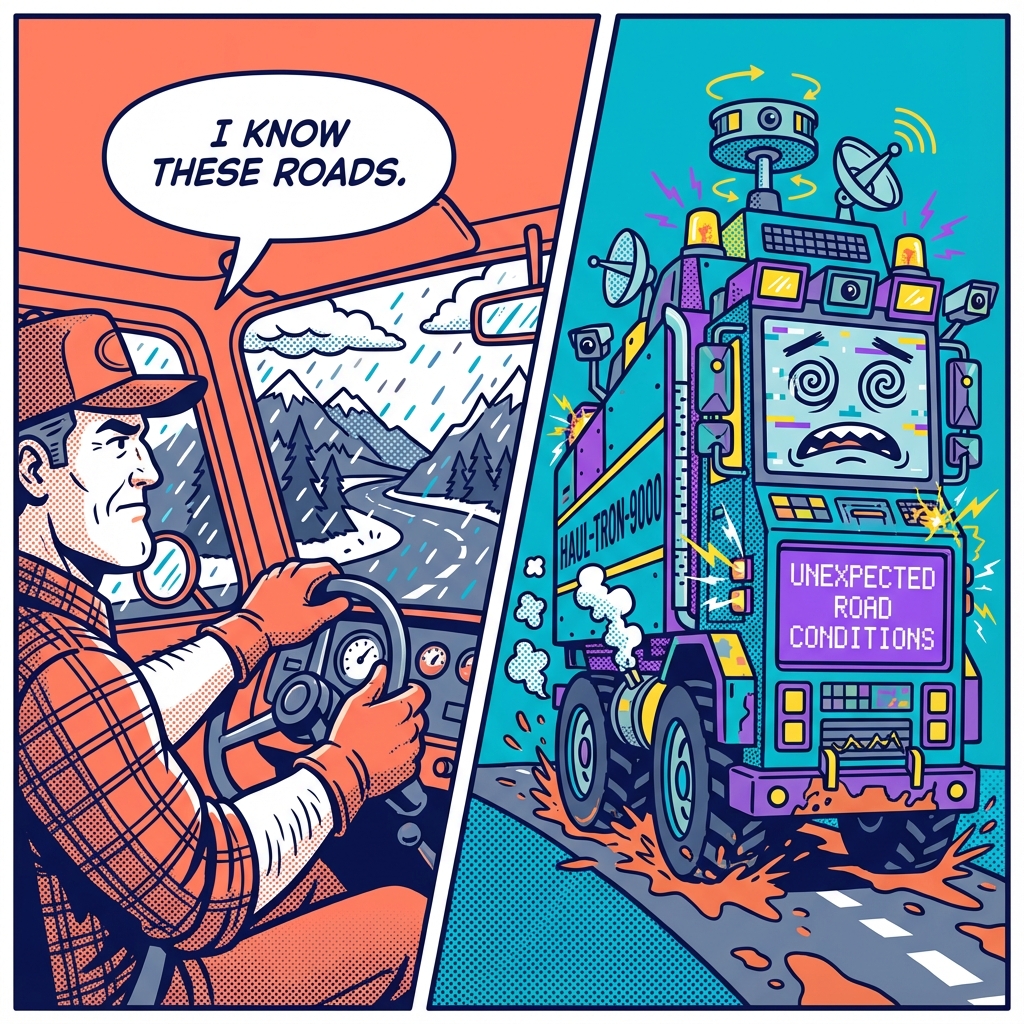
Will robots replace truck drivers? At 70% risk, highway routes are vulnerable. But last-mile delivery and complex routes? Still stubbornly human.
Highway long-haul is being automated first, but last-mile delivery, complex routes, and customer interaction remain stubbornly human. The drivers who win will specialize in what robots can't handle.
Will Robots Take My Trucking Job?
You're here because you've seen another headline about self-driving trucks, and you wondered if your CDL was about to become worthless. Here's what's actually happening.
We've Been Here Before: "Self-Driving in 5 Years" Since 2004
In 2004, DARPA's autonomous vehicle challenge saw every robot fail. Since then, we've heard "self-driving trucks are 5 years away" every single year for two decades.
There are MORE truck drivers today than in 2004, and the industry has a massive driver shortage.
Why? Because companies don't pay for highway miles. They pay for:
- Getting the load there intact and on time
- Handling unexpected situations (weather, road closures, breakdowns)
- Backing a 53-foot trailer into a tight loading dock
- Customer relationships and delivery coordination
- Problem-solving when plans fall apart
- Someone to blame when things go wrong
Self-driving trucks can cruise I-80. They can't navigate a flooded back road to a rural farm.
What AI/Robots Can Actually Do Today
Tasks Automation Wins At:
- Highway driving - Straight roads, good conditions (90%+ capability)
- Platooning - Following other trucks in convoy
- Route optimization - Finding fastest paths with AI
- Fuel efficiency - Maintaining optimal speeds
- Basic monitoring - Tire pressure, engine diagnostics
What Humans Still Dominate:
- Last-mile delivery - Navigating neighborhoods, construction zones, unmarked roads
- Dock maneuvering - Backing into tight spaces, dealing with obstacles
- Customer interaction - Signature collection, special instructions, building relationships
- Weather judgment - Knowing when to stop vs push through
- Problem-solving - Flat tires, accidents, road closures, cargo issues
- Load inspection - Verifying cargo, securing unusual loads
The Tasks Table: Robot vs Human
| Task | AI/Robot Capability | Human Advantage | Winner |
|---|---|---|---|
| Highway cruising | 90% | 10% - edge cases | Robot |
| Route planning | 85% | 15% - local knowledge | Robot |
| Fuel optimization | 80% | 20% - judgment calls | Robot |
| City navigation | 40% | 60% - unpredictability | Human |
| Loading dock backing | 20% | 80% - spatial awareness | Human |
| Customer interaction | 10% | 90% - relationships | Human |
| Bad weather driving | 25% | 75% - judgment | Human |
| Emergency response | 15% | 85% - quick thinking | Human |
| Load securing | 20% | 80% - physical + judgment | Human |
The Counter-Narrative: The Driver Shortage Is Getting Worse
Here's the surprising reality:
80,000 driver shortage in 2023 (American Trucking Association) 160,000 shortage projected by 2030 Average driver age: 46 and rising
Self-driving isn't replacing drivers—it might barely keep up with retirements.
The real transformation:
- Autonomous trucks handle boring highway miles
- Human drivers focus on complex first/last mile
- "Transfer hub" model: robots do highway, humans do cities
- Specialized routes become premium jobs
The Bottom Line
Yes, autonomous trucks will take over highway long-haul routes. No, autonomous trucks won't handle last-mile delivery, complex situations, or customer relationships anytime soon.
The drivers who thrive will be:
- Specialized (hazmat, oversized, refrigerated, regional)
- Customer-focused (building relationships that robots can't)
- Adaptable (learning to work alongside automation)
- Strategic (moving toward complex routes before forced to)
Your move: Get your hazmat or oversized endorsement this month. The drivers who struggle won't be replaced by robots—they'll be outcompeted by drivers who specialized in what robots can't do.
What's Next?
Ready to future-proof your career? Our AI Adaptation Guide covers the skills and strategies that matter across every profession—from embracing AI tools to doubling down on uniquely human strengths.