The New AI Jobs: Roles That Didn't Exist 2 Years Ago
AI Product Manager. HITL Reviewer. Prompt Engineer. Here are the new roles emerging—and how to position for them.
The Other Side of AI Disruption
Every story about AI eliminating jobs has a counterpart: AI creating jobs that didn't exist before.
Two years ago, "prompt engineer" wasn't a title. "AI Product Manager" was a niche specialization. "Human-in-the-Loop Reviewer" was a research term, not a job posting.
Now these roles are hiring. Some pay well. Many don't require a traditional CS background.
Here's what's emerging, what they actually involve, and how to position yourself.
The New Roles: What's Actually Being Hired
1. AI Product Manager
What it is: Product manager specializing in AI-powered features and products. Bridges the gap between what AI can do and what users need.
The role:
- Define product requirements for AI features
- Work with ML engineers to scope capabilities
- Design human-AI interaction flows
- Measure AI feature effectiveness
- Handle the unique challenges of AI products (accuracy vs. speed, explainability, edge cases)
Why it's different from regular PM:
- Must understand AI capabilities and limitations
- Must design for probabilistic outputs (AI isn't always right)
- Must define success metrics for AI (precision/recall, not just engagement)
- Must handle AI-specific user experience challenges
Skills required:
- Product management fundamentals
- Basic understanding of ML concepts (not necessarily coding)
- Data literacy (analyzing AI performance)
- User research for AI products
Who's hiring: Every major tech company, AI startups, companies deploying AI features
Salary range: $130,000-$200,000+ (varies by company and location)
Path in: Traditional PM experience + AI literacy, or technical role + PM transition
2. AI/ML Engineer (Expanded)
What it is: Not new, but the scope has exploded. Now includes specializations that didn't exist recently.
The subspecializations emerging:
LLM Application Engineer
- Build products using large language models
- Not training models, but using APIs effectively
- Prompt engineering, RAG systems, fine-tuning
- Lower barrier than traditional ML engineering
AI Agent Developer
- Build autonomous agent systems
- Multi-step reasoning, tool use, orchestration
- This is the "agentic AI" that forecasters predict will drive the next wave of job changes
Evaluation Engineer
- Design and run evaluations for AI systems
- Benchmark performance, identify failure modes
- Growing as companies need to prove AI reliability
Salary range: $150,000-$300,000+ for experienced roles
Path in: Software engineering + ML coursework, bootcamps (for LLM application work), or research background (for core ML)
3. Human-in-the-Loop (HITL) Reviewer
What it is: Human quality control for AI outputs. Reviews, corrects, and labels AI-generated content or decisions.
The role:
- Review AI outputs for accuracy
- Correct mistakes and provide feedback
- Label data for model improvement
- Handle escalations when AI is uncertain
- Maintain quality standards
Why it exists: AI systems make mistakes. In high-stakes domains (medical, legal, financial), humans must verify outputs. Even in lower-stakes domains, quality control is needed.
Skills required:
- Domain expertise (varies by industry)
- Attention to detail
- Understanding of AI capabilities and limitations
- Often: specific professional credentials (for regulated industries)
Who's hiring: AI companies, companies deploying AI in sensitive domains, data labeling companies (though often lower-paid)
Salary range: Wide range—$40,000-$150,000+ depending on domain expertise required
Important note: Some HITL roles are low-wage data labeling. Others (medical, legal, financial review) pay much more and require credentials.
Path in: Domain expertise is the key. A nurse reviewing medical AI outputs. A lawyer reviewing legal AI outputs. Your existing expertise becomes the qualification.
4. Prompt Engineer / AI Interaction Designer
What it is: Designing and optimizing prompts for AI systems. Has evolved from "write better prompts" to a broader discipline.
The evolution:
- 2023: "Write prompts that get good outputs"
- 2024: "Design prompt templates for production systems"
- 2025: "Design entire human-AI interaction flows"
The role today:
- Design prompt architectures for complex systems
- Optimize prompts for specific use cases
- Create evaluation frameworks for prompt effectiveness
- Build prompt libraries and best practices
- Often overlaps with AI Product Manager or LLM Engineer
Skills required:
- Excellent writing and communication
- Understanding of LLM behavior
- Testing and iteration mindset
- Domain knowledge (for specialized applications)
Salary range: $80,000-$150,000 (standalone role), higher when combined with engineering
Path in: Technical writing background, research experience, or engineering + communication skills
Note: Pure "prompt engineer" roles are becoming less common as the skill gets absorbed into other positions. The most valuable path is prompt engineering skills + something else (product, engineering, domain expertise).
5. AI Ethics & Governance Specialist
What it is: Ensuring AI systems are fair, safe, and compliant. Bridges technical AI work and policy/legal requirements.
The role:
- Audit AI systems for bias and fairness
- Develop AI governance frameworks
- Ensure regulatory compliance (EU AI Act, emerging US regulations)
- Handle AI incident response
- Create AI policies and guidelines
Why it's growing: Regulation is coming. The EU AI Act is being implemented. Companies need people who understand both the technical and policy sides.
Skills required:
- Understanding of AI systems (doesn't require coding)
- Policy and regulatory knowledge
- Ethics and philosophy background (helpful)
- Communication and documentation
Who's hiring: Large tech companies, companies in regulated industries, consulting firms, government
Salary range: $100,000-$180,000
Path in: Policy/legal background + AI literacy, or technical background + ethics/policy training
6. AI Agent Supervisor / Orchestrator
What it is: Manage and coordinate AI agent systems in production. The "manager of AI workers."
The role (emerging):
- Monitor AI agent performance
- Handle exceptions and escalations
- Coordinate multi-agent systems
- Ensure quality and consistency
- Manage the interface between AI agents and human workers
Why it's emerging: As agentic AI systems become more common, someone needs to supervise them. AI agents can handle routine tasks but need human oversight for edge cases, quality control, and strategic decisions.
Skills required:
- Understanding of AI agent architectures
- Operations management mindset
- Technical troubleshooting ability
- Domain expertise (varies by application)
Salary range: Unclear—role is still emerging. Likely $80,000-$150,000 depending on complexity
Path in: Operations background + AI literacy, or technical background + management experience
How to Position Yourself
Step 1: Audit Your Current Assets
What do you already have?
Technical skills?
- Coding → LLM Application Engineer, AI Agent Developer
- Data analysis → AI evaluation, HITL review (data-intensive)
- System design → AI architecture roles
Domain expertise?
- Healthcare → Medical AI review, healthcare AI PM
- Legal → Legal AI review, legal tech AI
- Finance → Financial AI review, fintech AI
- Writing/Communication → Prompt engineering, AI interaction design
Product/Business skills?
- Product management → AI Product Manager
- Operations → AI Agent Supervisor
- Strategy/Policy → AI Ethics & Governance
Step 2: Fill the Gap
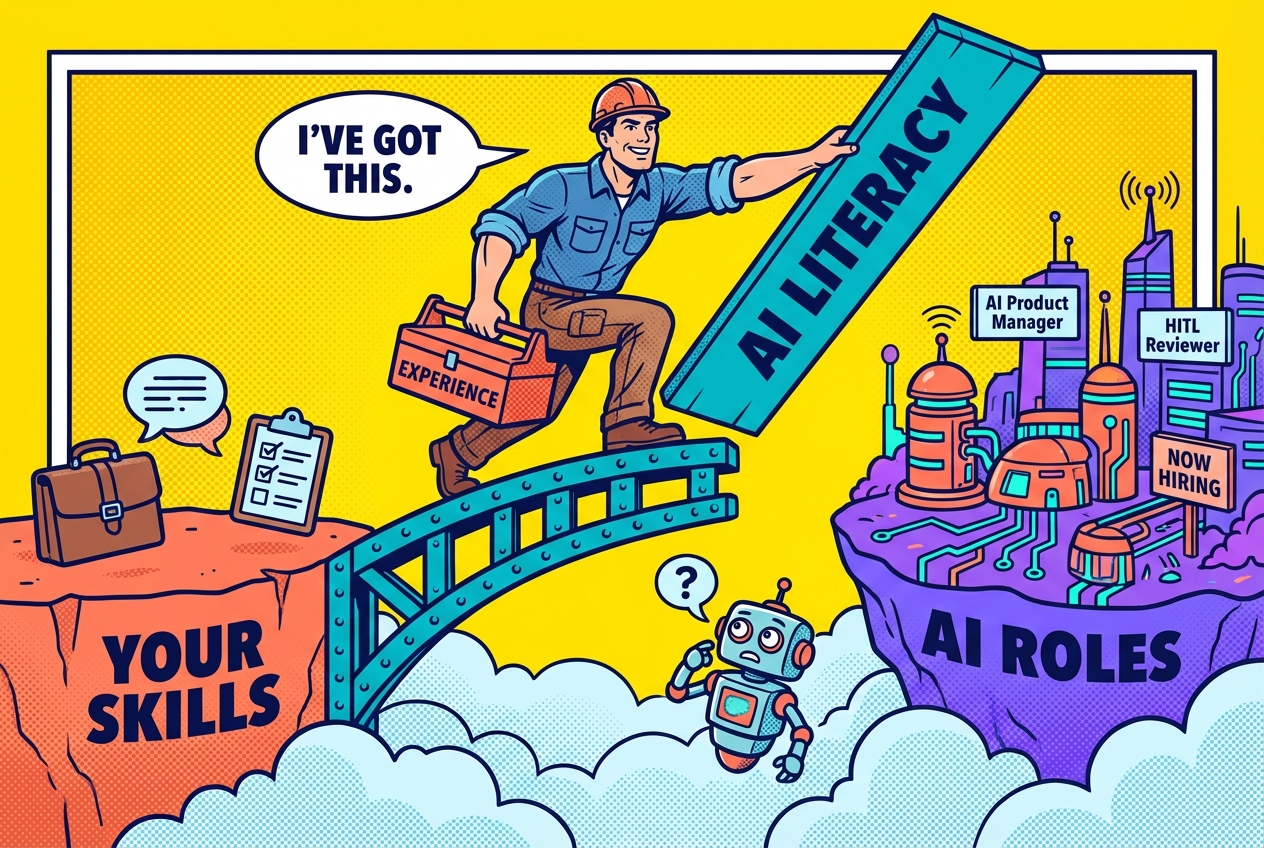
Most new AI roles require: Your existing expertise + AI literacy
AI literacy means:
- Understanding what LLMs can and can't do
- Basic familiarity with prompting and fine-tuning concepts
- Understanding AI product challenges (hallucinations, accuracy tradeoffs)
- Hands-on experience with AI tools
You don't need:
- A PhD in machine learning
- Ability to train models from scratch
- Deep mathematics background
Step 3: Build Proof of Work
For technical paths:
- GitHub projects using AI APIs
- Contributions to open source AI tools
- Blog posts about AI development challenges
For product/business paths:
- Writing about AI product strategy
- Case studies of AI implementation
- Side projects demonstrating AI product thinking
For domain expert paths:
- Writing about AI in your field
- Demonstrations of AI tool usage in your domain
- Network in AI + your industry intersections
The Realistic View
What's Actually Hiring (Right Now)
High demand:
- AI Product Managers (at companies deploying AI features)
- LLM Application Engineers (at AI startups and AI-forward companies)
- HITL Reviewers (in regulated industries)
Emerging demand:
- AI Agent Developers (as agentic systems mature)
- AI Governance roles (as regulation increases)
- AI Evaluation specialists (as reliability becomes critical)
Uncertain demand:
- Pure "Prompt Engineer" (being absorbed into other roles)
- AI Trainers/Data Labelers (often low-wage, high turnover)
Salary Reality Check
The top-end salaries in AI roles are real but not universal:
- AI roles at top tech companies: $200K-$400K+
- AI roles at startups: $120K-$200K
- AI roles at traditional companies: $80K-$150K
- HITL/data labeling: $15-$25/hour at the low end, much higher with domain expertise
The pattern: Your existing expertise determines your AI salary. A nurse doing medical AI review makes more than a generalist doing data labeling.
The Timeline
Available Now
- AI Product Manager
- LLM Application Engineer
- HITL Reviewer (especially domain-specific)
- AI Ethics (at larger companies)
Growing in 2025-2026
- AI Agent Developer
- AI Evaluation Specialist
- AI Operations/Supervisor roles
Emerging
- AI-Human Coordination roles
- Domain-specific AI specialist combinations
- Regulatory/compliance AI roles (as laws solidify)
The Action Plan
This Week:
- Identify your angle - What do you bring that others don't?
- Start using AI tools daily - ChatGPT, Claude, Copilot—hands-on experience matters
- Pick ONE role type that matches your background
This Month:
- Fill the knowledge gap - Take a course on AI fundamentals (many free options)
- Build one proof-of-work project - Demonstrate you can work with AI
- Start writing/talking about AI in your field
This Quarter:
- Apply to relevant roles - Don't wait until you feel "ready"
- Network in AI + your domain - LinkedIn, conferences, communities
- Iterate based on feedback - Learn what employers actually want
The Bottom Line
AI is eliminating jobs AND creating jobs. The people best positioned for new roles aren't necessarily the most technical—they're the ones who can combine AI literacy with existing expertise.
The playbook:
- Don't start from zero - Your background is an asset
- Add AI literacy - You don't need to become an ML engineer
- Build proof - Show, don't tell
- Position specifically - "AI in healthcare" > "AI generalist"
The new jobs exist. They're hiring. The question is whether you'll position yourself to get them.
Related Reading
- 2025 Tech Layoffs - The other side of the AI jobs story
- Junior Developer - How entry-level tech is evolving
- Software Engineer - The broader engineering picture
- What People Actually Pay For - Why trust and judgment survive automation
Sources
Industry Research:
- McKinsey Global Institute - "Agents, Robots, and Us: Skill Partnerships in the Age of AI" (2025)
- Forbes predictions on AI workforce evolution
Job Market Data:
- LinkedIn AI role postings
- Company job boards (reviewed for emerging role patterns)
Note: New AI roles are evolving rapidly. Role definitions and requirements may shift as the field matures.
Last Updated: December 2025